


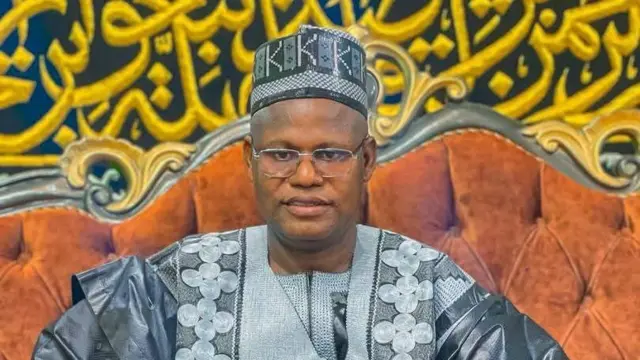
COLUMN: On the Killing of Masussuka, by Alabidun Shuaib AbdulRahman
Religion is supposed to illuminate the human conscience, not extinguish the lives of those who understand it differently. Yet, in a country where religious differences are increasingly manipulated by extremists, the murder of Sheikh Yahaya Ibrahim Masussuka in Dutsin-Ma, Katsina State, on October 26, 2026, presents a disturbing thought.
A Muslim preacher who reportedly advocated peaceful coexistence between Christians and Muslims was allegedly targeted because his religious convictions and public positions offended those who claimed to defend Islam. If the circumstances surrounding his assassination and the subsequent claim of responsibility by Ansaru are established, it means there is fire on the mountain.
Masussuka, 47, was reportedly shot alongside his associate, Adamu Abubakar, by two motorcycle-riding gunmen outside his residence. Both men were taken to a nearby hospital but were pronounced dead. The Katsina State Police Command confirmed the incident and announced the deployment of security personnel to apprehend the perpetrators.
Born in Bauchi State but resident in Dutsin-Ma, Masussuka reportedly began preaching in Quranic schools at 13, studied at Al-Azhar University in Egypt and pursued further studies in Oman. He was associated with a Quran-centred interpretation of Islam, questioning the authority of certain Hadith traditions and rejecting some established teachings concerning life after death. These positions generated disagreements with mainstream Islamic scholars, particularly those who consider the Sunnah indispensable to understanding the Qur’an and practising Islam.
READ ALSO: NITDA DG challenges African innovators to build global tech enterprises
His views were controversial, but as it should be, controversy is not a crime punishable by death. Islamic scholarship has historically accommodated disagreements over theology, jurisprudence and interpretation. Scholars have challenged one another, defended competing positions and subjected religious arguments to rigorous intellectual examination. Such disagreements are part of scholarship.
Masussuka’s activities extended beyond preaching. In April 2024, he established Qur’an TV/Radio and Masussuka International School in Dutsin-Ma, combining religious and conventional education. He also used social media to communicate his teachings. His advocacy for peaceful coexistence earned him a Peace Ambassador Award from the Network for Good Governance and Transparency in June 2025.
More significantly, he was preparing to organise a peace gathering on October 31, 2026, barely five days after his murder. In a recorded message concerning the event, he spoke about restoring the cordial relationships that once existed among people of different religious persuasions. There is a painful irony in the fact that a man preparing to convene a gathering for peace was killed before he could host it.
His disagreements with other Islamic scholars had previously attracted government attention. In November 2025, the Katsina State Government summoned him following complaints about his teachings. The government also acknowledged his complaints about insults and threats from individuals he associated with Jama’atu Izalatil Bidia Wa Ikamatus Sunna, popularly known as JIBWIS. The matter was referred to the Katsina Emirate Council, while Governor Dikko Umaru Radda directed him to appear before a committee of Islamic scholars.
There is no established evidence that JIBWIS, as an institution, ordered or participated in his assassination. Indeed, Imam Ibrahim Aliyu Kaduna, a JIBWIS official speaking in his personal capacity, condemned the killing despite disagreeing with Masussuka’s religious positions.
The most disturbing development came on October 27, when Jama’atu Ansarul Muslimina Fi Biladis Sudan, popularly known as Ansaru, reportedly claimed responsibility for the assassination in a four-minute video obtained by PREMIUM TIMES. The group allegedly described Masussuka as an infidel and accused him of confusing Muslims and undermining Islam. His advocacy for interfaith coexistence and disagreement with certain Hadith traditions were reportedly cited among the reasons for his killing. It also threatened others accused of belittling the Hadith.
Although the claim requires independent investigation and must not be mistaken for conclusive proof of the identities of the attackers, its ideological implications are frightening. It suggests that an armed organisation believes it possesses the authority to determine the boundaries of religious orthodoxy and eliminate anyone who falls outside them.
What kind of religious belief requires the murder of another person to establish its authority? What kind of faith cannot withstand intellectual disagreement? And what kind of movement mistakes the elimination of an ideological opponent for the defence of religion?
Nigeria has witnessed the destructive consequences of extremist ideologies through the Boko Haram insurgency and other violent organisations. The reported circumstances of Masussuka’s death should therefore be treated as a serious security warning.
Perhaps the greatest injustice in this tragedy is the attempt to present intolerance and murder as expressions of Islamic devotion. The Qur’an is explicit on religious freedom. Surah Al-Baqarah, verse 256, declares: “There is no compulsion in religion.” This principle leaves little room for anyone to claim that faith can legitimately be imposed through threats or violence.
In Surah Al-Mumtahanah, verse 8, Allah permits kindness and justice towards those who neither fight Muslims on account of religion nor drive them from their homes. Surah Al-Hujurat, verse 13, further explains that humanity was created in different nations and tribes so that people might know one another. Diversity is therefore not an invitation to hostility.
More importantly, Surah Al-Ma’idah, verse 32, describes the unlawful killing of an innocent person as comparable to killing all humanity, while saving a life is likened to saving all humanity. The Hadith recorded in Sahih al-Bukhari also warns against killing a non-Muslim who enjoys a covenant of protection.
These teachings cannot reasonably be reconciled with the deliberate assassination of people because of their religious opinions or relationships with adherents of other faiths.
This does not mean Masussuka’s theological positions were beyond criticism. Imam Ibrahim Aliyu Kaduna argued that the Sunnah is indispensable to understanding Islamic worship, including the practical requirements of prayer and pilgrimage. That is a legitimate scholarly position. Other scholars have every right to challenge Masussuka’s rejection of certain Hadith traditions and defend their understanding of Islam through evidence and reason. But disagreement must remain within the boundaries of peaceful engagement.
A religion confident in its teachings does not need armed men to defend it. Knowledge, scholarship, persuasion and moral example are stronger instruments of religious conviction than intimidation and murder.
Islamic jurisprudence treats murder as one of the gravest offences. Surah Al-Baqarah, verse 178, establishes Qisas, or lawful retribution, while recognising forgiveness and compensation, known as Diyah, within the prescribed legal framework. This is not an invitation for individuals or organisations to appoint themselves judges and executioners. Justice requires evidence, lawful adjudication and competent judicial authority.
Nigeria’s Constitution is equally clear. Section 33 of the 1999 Constitution protects the right to life, while Section 38 guarantees freedom of thought, conscience and religion. Murder attracts the prescribed criminal punishment when established through due process. Where evidence establishes a terrorist motive or involvement, applicable provisions of the Terrorism (Prevention and Prohibition) Act 2022 may also be invoked.
The Katsina State Government must also explain what followed its November 2025 intervention. Having received complaints concerning threats and religious disagreements surrounding Masussuka, were the allegations investigated? Were protective measures considered? Did the authorities assess the possibility that the dispute could escalate into violence? These questions deserve answers, not as an attempt to assign blame without evidence, but to determine whether preventable warning signs were overlooked.
The police must identify and prosecute everyone involved in the murders of Masussuka and Abubakar, including those who planned, financed or facilitated the operation. Religious identity must not become protection from criminal accountability.
Religious leaders, meanwhile, must confront the misuse of takfir, the practice of declaring another Muslim an unbeliever, particularly when it is employed to legitimise persecution and violence. No theological disagreement gives anyone the authority to take another person’s life.
Masussuka was not infallible, and his teachings should remain open to scholarly scrutiny. But neither his controversial positions nor his advocacy for interfaith coexistence justified his murder. His death must not become another opportunity for religious factions to trade accusations or deepen divisions.
The best way to honour Masussuka is not to endorse every theological position he held, but to defend the fundamental right to life, freedom of conscience and peaceful coexistence. A society that allows people to be killed for interpreting religion differently has surrendered both its humanity and its sense of justice.
Faith should inspire conviction, not violence. And no individual, however loudly he claims to defend religion, has the authority to place himself above the sanctity of human life.
Alabidun is a media practitioner and can be reached via alabidungoldenson@gmail.com


