


The Electoral Act and the Crisis of Electoral Confidence
By Alabidun Shuaib AbdulRahman
Nigeria’s electoral laws have always mirrored the country’s uneasy relationship with democracy itself: hopeful in intention, fragile in execution, and controversial in outcome.
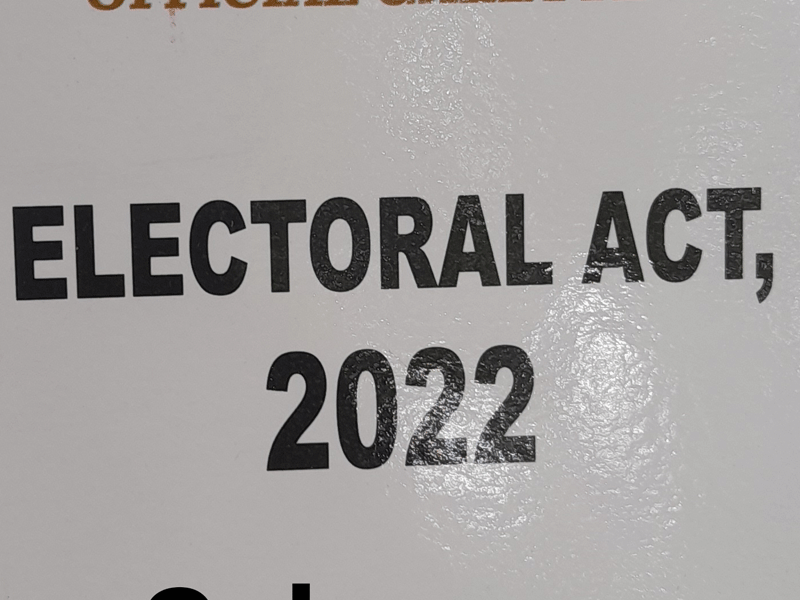
From the annulled June 12, 1993 election to the disputed polls of 2003, 2007, 2019 and, more recently, 2023, electoral legislation has remained both a tool of reform and a battlefield of political interest. The Electoral Act 2022, currently at the centre of renewed controversy, was enacted to correct decades of systemic flaws, but its implementation and the subsequent attempts to amend it have reopened old wounds about trust, transparency and the true commitment of Nigeria’s political elite to credible elections.
The Electoral Act 2022 replaced the Electoral Act 2010 (as amended), which had governed Nigeria’s elections for over a decade. The 2010 Act was widely criticised for being outdated in the face of evolving electoral manipulation techniques, weak in enforcing penalties for offences, and largely silent on the use of modern technology.
READ ALSO: TDF Hails Reported N6tn Gains from Tinubu’s Downstream Reforms
Between 1999 and 2019, election tribunals nullified hundreds of election results across all levels of government, presenting how deeply flawed the process had become. According to data from the National Judicial Council, more than 40 per cent of governorship elections conducted between 1999 and 2015 ended up in court, with several overturned. This pattern exposed the limits of electoral administration under existing laws and created an urgent demand for reform.
Against this background, the Electoral Act 2022 was introduced as a reformist statute designed to restore confidence in Nigeria’s electoral process. It introduced innovations such as the legal backing for electronic accreditation of voters through the Bimodal Voter Accreditation System (BVAS), the possibility of electronic transmission of results, stricter timelines for party primaries, clearer campaign finance limits, and stiffer penalties for certain electoral offences. For the first time, Nigerian electoral law appeared to acknowledge that technology could serve as a bulwark against manipulation rather than a threat to sovereignty.
Yet, even at birth, the Act was controversial. Section 84, which barred political appointees from voting or being voted for at party primaries unless they resigned their appointments, generated intense legal and political resistance. While reform advocates argued that it would curb abuse of state power during primaries, opponents saw it as discriminatory. The provision was eventually nullified by the courts, making a recurring weakness in Nigeria’s electoral reform efforts: ambitious laws that collide with entrenched political interests and constitutional ambiguities.
The controversy surrounding the Act deepened after the 2023 general elections. Although BVAS significantly reduced incidents of over-voting, with INEC reporting that accreditation figures matched votes cast in most polling units, the failure to consistently upload polling-unit results to the INEC Result Viewing Portal in real time ignited nationwide outrage. INEC blamed technical glitches and connectivity challenges, but many Nigerians interpreted the delay as evidence that old habits had merely adapted to new tools. According to observer reports by the European Union Election Observation Mission, while BVAS improved transparency at the polling unit level, the collation process remained vulnerable to manipulation, particularly where results were moved physically without immediate electronic verification.
It is within this climate of suspicion that the National Assembly’s recent attempts to amend the Electoral Act have drawn fierce public scrutiny. Central to the controversy is the issue of electronic transmission of results. The Act currently empowers INEC to determine the manner in which results are transmitted, a provision that reformers argue is too discretionary. Civil society organisations, opposition parties and segments of the electorate insist that mandatory electronic transmission from polling units should be explicitly stated in the law to eliminate human interference during collation. Their argument is rooted in history: most electoral fraud in Nigeria has occurred not at the polling unit, where party agents and observers are present, but during result collation at ward, local government and state levels.
Supporters of legislative discretion counter this argument by pointing to Nigeria’s uneven infrastructure. They note that, according to the Nigerian Communications Commission, broadband penetration stood at 43.71% as at December 2023,, with significant disparities between urban and rural areas. From this perspective, making electronic transmission mandatory without addressing connectivity and power supply challenges could disenfranchise voters in remote communities. This disparity between ideal reform and practical constraints lies at the heart of the Electoral Act debate.
Beyond technology, the Act also touches on the persistent problem of electoral offences. Vote-buying, ballot snatching and voter intimidation have become entrenched features of Nigeria’s elections. During the 2023 elections, Yiaga Africa documented widespread vote trading across several states, with prices reportedly ranging from ₦2,000 to ₦10,000 per vote. The Electoral Act prescribes fines and prison terms for such offences, yet enforcement remains weak. Nigeria has recorded very few convictions for electoral crimes since 1999, a fact acknowledged by INEC itself.
The implications of these legal controversies for future elections, particularly the 2027 general elections, are profound. Electoral credibility is not built on election day alone; it depends on clarity and stability of the legal framework long before ballots are printed. INEC is required by law to release its election timetable at least 360 days before a general election. Persistent uncertainty about the final shape of the Electoral Act complicates planning, procurement and training. It also increases the likelihood of pre-election litigation, which has already become a defining feature of Nigerian politics.
In the 2023 election cycle, INEC recorded over 1,200 pre-election cases, many of which stemmed from ambiguities in party primaries and candidate selection rules.
Public trust is another casualty of the ongoing controversy. Voter turnout in Nigeria has been declining steadily, dropping from about 69 per cent in 2003 to roughly 27 per cent in 2023, according to INEC figures. This decline reflects growing voter apathy driven by the perception that votes do not count. When electoral laws appear malleable or subject to political bargaining, they reinforce cynicism and disengagement. For a country where over 60 per cent of the population is under 30, sustaining such distrust poses long-term risks to democratic stability.
Still, it would be unfair to dismiss the Electoral Act 2022 as a failure. The Act represents the most comprehensive attempt at electoral reform Nigeria has undertaken since 1999. The legal recognition of technology in voter accreditation marked a decisive break from the past, and the reduction in over-voting during the 2023 elections is a measurable achievement.
The clearer timelines for party primaries and candidate nominations have also improved internal party discipline, even if enforcement remains inconsistent. Compared to elections conducted under the 2010 Act, the 2022 framework has narrowed some avenues for manipulation, even as it exposed others.
The negative side, however, lies in what the Act leaves unresolved. Ambiguity in critical areas creates room for discretion, and discretion in Nigeria’s electoral history has rarely favoured transparency. The absence of decisive enforcement mechanisms for electoral offences undermines deterrence. The tendency to amend election laws close to election seasons fuels suspicion that reforms are driven by immediate political calculations rather than long-term democratic consolidation.
Nigeria’s electoral journey is ultimately a reflection of its broader governance challenges. Laws alone cannot guarantee credible elections, but weak laws almost certainly guarantee flawed ones. The controversy surrounding the Electoral Act is therefore less about technical clauses and more about political will. Countries such as Ghana and Kenya, which have faced similar challenges, have shown that sustained reform, backed by enforcement and civic education, can gradually rebuild trust. Ghana’s consistent improvement in election credibility since 2000, for instance, has been supported by clear electoral rules and visible consequences for violations.
As Nigeria looks ahead to future elections, the Electoral Act remains a pivotal instrument. Whether it becomes a foundation for democratic consolidation or another missed opportunity depends on how sincerely it is implemented, clarified and respected.
Electoral reform is not an event but a process, and Nigeria is still very much in the middle of that process. What is at stake is not just the outcome of the next election, but the credibility of the democratic project itself. In that sense, the controversy over the Electoral Act is not a distraction from Nigeria’s democratic journey; it is the journey, unfolding in real time, with all its contradictions, hopes and unresolved questions.
Alabidun is a media practitioner and can be reached via alabidungoldenson@gmail.com


