


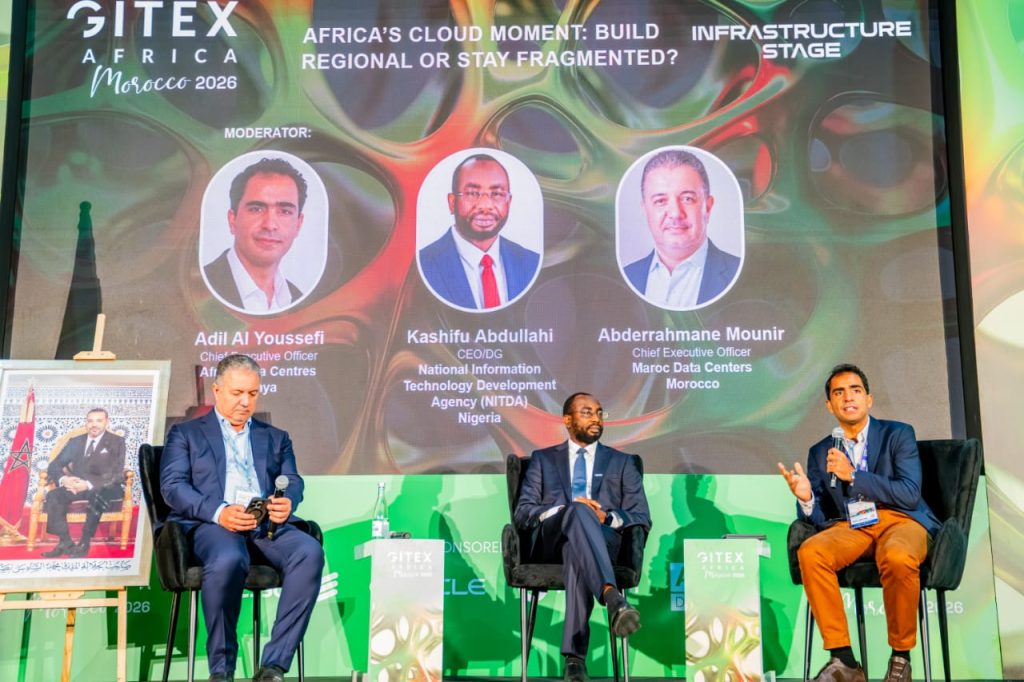
Inuwa Urges Africa to Build Local Cloud Infrastructure, Warns of Digital Dependence
By Alabidun Shuaib AbdulRahman
The Director-General of the National Information Technology Development Agency, NITDA, Kashifu Inuwa, has called on African nations to urgently develop domestic cloud infrastructure and assert data sovereignty, warning that failure to act could entrench long-term digital dependence on foreign powers.
Inuwa made the call during a high-level session at the GITEX Africa 2026 held in Morocco, where he stressed that Africa must transition from being a passive consumer of foreign technology to becoming a key architect of its digital ecosystem.
He warned that the continent’s fragmented digital landscape exposes it to external disruptions and undermines efforts to build an integrated digital economy.
Describing the global digital environment as one driven by rapid data processing and intelligent systems, Inuwa said digital integration has become essential for national survival.
READ ALSO: Nigeria Adopts ‘Total Resilience’ Strategy Against Rising Cyber Threats — NITDA DG
He likened cloud infrastructure to a life-support system, raising concerns over control of critical digital resources.
“Digital is no longer optional; it is a way of life, and the cloud is the oxygen that sustains that life. The question is: who controls that oxygen?” he said.
The NITDA boss advocated a shift towards localised data storage and autonomous computing capacity, noting that reliance on foreign cloud providers leaves African countries vulnerable to external policy changes and geopolitical interests.
He called for a federated regional approach that would enable countries to pool resources and expertise to build a resilient African cloud ecosystem, ensuring that data generated within the continent is harnessed for local innovation and economic growth.
Inuwa expressed concern over Africa’s limited stake in global digital infrastructure, noting that despite accounting for up to 19 per cent of the world’s population, the continent controls only about 0.6 per cent of global data centre and computing capacity.
He described the disparity as a “sovereignty gap,” warning that lack of control over data storage and processing poses risks to national security, economic independence, and policy autonomy.
“This is not just a technology gap; it is a sovereignty gap. We are generating data, but we are not in control of how and where that data is stored, processed, or monetised,” he said.
While acknowledging the challenges, Inuwa highlighted Africa’s growth potential, citing its youthful population, rising internet penetration, and expanding startup ecosystem as key advantages.
He, however, stressed that no single country could achieve digital sovereignty alone, urging governments, private sector players, and regional institutions to collaborate on shared infrastructure.
“There is no single country in Africa that can do this alone. We must integrate our efforts and build shared systems that benefit the entire continent,” he added.
Central to his proposal is the development of a “cloud of clouds” — a federated system linking national and regional cloud platforms into a unified network that allows data control alongside cross-border collaboration.
He referenced Europe’s Gaia-X initiative as a model, noting that while Africa’s context differs, the principle of a trusted and interconnected cloud ecosystem remains relevant.
Inuwa clarified that cloud sovereignty does not equate to digital isolation, but rather the ability of nations to define their own standards and control their technological future.
He added that investing in indigenous cloud infrastructure could unlock economic benefits such as job creation, innovation, improved digital services, and increased investor confidence, while positioning Africa competitively in emerging technologies like artificial intelligence and big data.
The NITDA DG further stressed that digital sovereignty is a strategic necessity for long-term stability, urging African nations to act collectively to secure their digital future or risk further marginalisation in the global digital economy.


