


NDC As A New Bride
By Alabidun Shuaib AbdulRahman
In Nigerian politics, new parties arrive the way comets appear in troubled skies. They appear suddenly, brightly and with exaggerated promises of redemption. Every election cycle births another coalition of disappointed politicians, frustrated elites, restless youths and displaced loyalists seeking what they call a “new direction.” Yet history has not been kind to many of them. Most vanish into the crowded cemetery of political irrelevance even before the next electoral season matures.
But the emergence of the Nigeria Democratic Congress, NDC, appears different in timing, symbolism and political calculations. Whether it ultimately becomes a genuine ideological alternative or merely another temporary shelter for ambitious politicians remains one of the defining political questions ahead of the 2027 general elections. The metaphor of a “new bride” fits perfectly.
In African culture, especially within the Nigerian sociopolitical imagination, a new bride arrives adorned with admiration, expectations, curiosity and suspicion. Everybody wants to see her. Everybody praises her beauty. Everybody speculates about her future. But beyond the wedding glamour lies the difficult burden of sustaining a home. That is precisely the present condition of the NDC in Nigeria’s political arena.
READ ALSO: Nigeria, Chinese firm partner on EV manufacturing in Lagos, Abuja
Officially recognised by the Independent National Electoral Commission, INEC on February 5, 2026, the NDC emerged alongside the Democratic Leadership Alliance after a prolonged legal and administrative process. INEC Chairman, Professor Joash Amupitan, disclosed that while DLA passed the conventional registration requirements, the NDC secured recognition through a Federal High Court order from Lokoja, Kogi State. That detail is politically important.
Unlike parties organically nurtured through ideological evolution, the NDC entered the national consciousness through judicial intervention. In Nigeria, where courts increasingly shape political destinies from governorship victories to legislative leadership tussles, the judiciary has become an unofficial co-author of democratic processes.
Nigeria’s political atmosphere today resembles a nation exhausted by recycled promises. The ruling All Progressives Congress, APC continues to face criticism over inflation, insecurity, unemployment and rising public frustration. Meanwhile, the opposition Peoples Democratic Party, PDP remains weakened by prolonged internal crises, leadership disputes and ideological confusion. The Labour Party, despite its emotional 2023 momentum, has struggled to convert populist enthusiasm into durable institutional structure. That vacuum created the perfect political maternity ward for another party. And Nigerians, perpetually hopeful despite repeated disappointments, naturally turned their attention toward the newcomer.
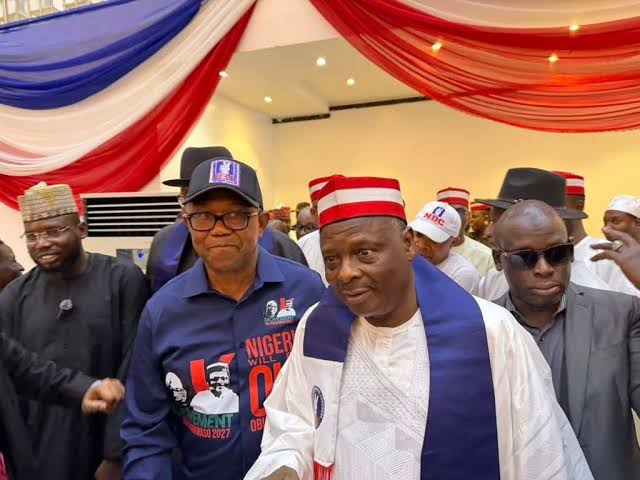
Already, the NDC is being discussed not merely as another registered party among Nigeria’s political parties, but as a possible coalition platform for displaced opposition figures seeking a stronger vehicle for 2027. The discussion intensified dramatically in early May 2026 following the formal defection of two of Nigeria’s most influential opposition politicians, Peter Obi and Rabiu Musa Kwankwaso. Their entrance transformed the NDC overnight from a little-known political organization into a major national conversation.
On May 3, 2026, both politicians were formally welcomed into the party during a high-profile political gathering held at the Abuja residence of former Bayelsa State governor, Seriake Dickson, who now serves as the NDC’s national leader. The event attracted political stakeholders, party officials and supporters from different regions of the country. During the gathering, Obi and Kwankwaso received their membership cards and addressed supporters on the future of the party.
Kwankwaso reportedly urged Nigerians interested in contesting future elections to register with the party immediately, while Obi spoke about building “a united, secure and prosperous Nigeria.” The symbolism of that event was impossible to ignore.
Obi remains one of the most influential opposition figures among Nigerian youths, especially after his remarkable performance in the 2023 presidential election under the Labour Party. Kwankwaso, on the other hand, commands a formidable grassroots structure in Northern Nigeria through the Kwankwasiyya movement. Their movement into the NDC instantly gave the party national visibility, regional balance and electoral seriousness. But the NDC did not stop there.
In recent weeks, the party has increased nationwide consultations and political receptions aimed at attracting defectors from other parties. Reports indicate that politicians from the APC, PDP, ADC and other opposition platforms have begun gravitating toward the NDC amid growing dissatisfaction within their former parties.
One of the earliest prominent figures to join was Amanda Pam, a notable Federal Capital Territory politician and former Deputy National Legal Adviser of the PDP. Senator Dickson personally received her into the party in April, describing the NDC as a growing ideological platform for national renewal.
More recently, the party also welcomed activist and social commentator Aisha Yesufu into its fold. On May 6, Yesufu announced her resignation from the ADC and formally declared for the NDC, revealing plans to contest the FCT Senatorial seat under the party’s platform.
Aisha Yesufu is not merely a politician. She represents a generation of activist-driven political consciousness that gained prominence during the Bring Back Our Girls campaign, the EndSARS protests and the Obi political movement of 2023. Her entrance into the NDC signaled the party’s attempt to combine elite political experience with activist energy.
The party has also recorded gains within legislative circles. Several members of the House of Representatives reportedly defected to the NDC shortly after Obi and Kwankwaso joined the party.
In another notable development, serving lawmakers from Edo State, including Natasha Osawaru Idibia, were formally received into the NDC during a political gathering in Abuja where Dickson warned against what he described as “transactional politics.” Former Gombe State Deputy Governor, John Lazarus Yoriyo, also joined the party at the same event. These activities have helped project the image of a party aggressively building momentum ahead of 2027. Yet the “new bride” metaphor remains politically dangerous.
Nigerians have a troubling habit of romanticising political newcomers. Every emerging movement is prematurely treated as a revolutionary salvation before its ideological foundation is properly interrogated. The country witnessed this phenomenon during the formation of the APC in 2013 when many Nigerians celebrated it as the coalition that would permanently rescue the nation from PDP dominance. Yet barely a decade later, many citizens who once celebrated that coalition now lament worsening economic hardship and democratic disappointments.
The NDC must answer difficult questions beyond the excitement of novelty. What exactly does it ideologically represent? Is it socially democratic? Progressively reformist? Or merely an emergency political apartment for frustrated elites seeking electoral shelter and survival?
So far, public discourse surrounding the party appears driven more by personalities than philosophy. That is Nigeria’s recurring democratic tragedy. Parties often revolve around influential politicians rather than coherent ideological convictions. In advanced democracies, voters can reasonably predict policy directions from party identity. In Nigeria, politicians migrate between parties with the emotional attachment of passengers changing commercial buses at Ojota.
Today’s progressive becomes something else tomorrow without ideological explanation. That is why Nigerians increasingly struggle to distinguish one party from another beyond slogans, logos and campaign colours. The NDC therefore faces an urgent intellectual responsibility: defining itself before defections define it.
A political party cannot sustainably survive on borrowed popularity alone. Emotional momentum without ideological infrastructure eventually collapses under the weight of ambition. The Labour Party’s post-2023 internal turmoil demonstrated this reality vividly. Popular movements may win elections, but only organized institutions sustain political relevance. This explains why many observers remain cautiously curious about the NDC.
Although there is undeniably a growing appetite among young Nigerians for alternative politics. Nigeria possesses one of the world’s youngest populations, with a median age below 20 years. Yet governance remains dominated by older political establishments. The frustration among youths over unemployment, inflation, educational instability and migration pressures has intensified demands for political renewal. Under such conditions, a disciplined opposition platform can become electorally dangerous to incumbents. But danger to incumbents alone does not equal democratic transformation.
Nigeria does not merely need another election-winning machine. It needs parties capable of institutionalizing governance culture, respecting internal democracy and nurturing ideological clarity. Without these, power simply changes occupants while dysfunction retains ownership of the system.
This is why the NDC must resist the temptation of becoming merely an anti-APC emotional coalition. Opposition built solely around anger eventually collapses after electoral seasons. Sustainable parties require philosophical substance beyond resentment against incumbents.
Equally important is the moral burden now facing the NDC’s emerging leadership. Nigerians are increasingly skeptical of political migration motivated purely by electoral convenience. When politicians defect without explaining ideological disagreements, citizens interpret movements as elite survival strategies rather than principled repositioning.
Social media discussions surrounding Obi and Kwankwaso’s movement to the NDC reflect this division clearly. While supporters view the party as a fresh opposition alternative, critics argue that repeated defections among Nigerian politicians expose the absence of ideological discipline within the political class. Such skepticism is understandable.
Nigeria’s democratic history contains too many abandoned promises. Yet democracy itself thrives on the possibility of renewal. Citizens cannot permanently surrender political hope simply because previous experiments failed. The challenge lies in balancing optimism with critical vigilance.
That balance is exactly how Nigerians should approach the NDC. Admire the bride if you wish. Celebrate the wedding if necessary. But do not ignore the marriage questions.
Can the party survive beyond electoral convenience? Can it manage internal imbroglio, if any arise? Can it resist godfather domination? Can it build structures beyond social media enthusiasm? Can it offer governance ideas beyond opposition rhetoric? Can it institutionalize internal democracy better than existing parties?
Those questions matter far more than registration certificates and ceremonial declarations. For now, however, the bride remains attractive because she is still largely undefined. And perhaps that is both her greatest strength and most dangerous weakness.
Alabidun is a media practitioner and can be reached via alabidungoldenson@gmail.com


