


NITDA Urges MDAs to Adopt AI Responsibly, Prioritise Human Oversight
By Alabidun Shuaib AbdulRahman
The Director-General of the National Information Technology Development Agency (NITDA), Kashifu Inuwa, has urged Ministries, Departments and Agencies (MDAs) to adopt Artificial Intelligence (AI) responsibly, warning that human accountability, policy frameworks and continuous digital skills development must remain central to public sector innovation.
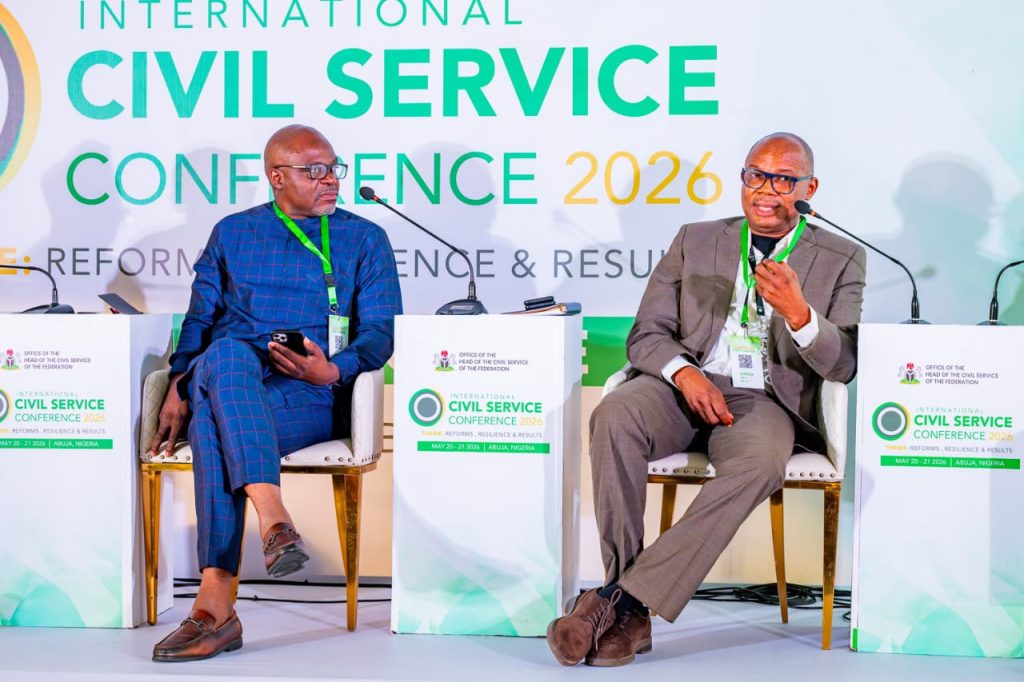
Inuwa made the call at the International Civil Service Conference 2026 held at the Eagles Square in Abuja, where he was represented by the Director of Stakeholder Management and Partnership at NITDA, Dr Aristotle Onumo.
He said the agency has already commenced the implementation of a three-year AI Transformation Plan aimed at repositioning NITDA for improved institutional efficiency, productivity and continuity, even in the face of staff transitions.
According to him, the initiative is designed to ensure seamless operations within the agency regardless of changes in personnel.
“In NITDA as an agency, we have what we call the AI Transformation Plan. It is a kind of three-year plan which we have put in place so that even if the current staff are replaced completely, new personnel should be able to interact with the system and continue work without hindrance,” he said.
READ ALSO: DHQ Dismisses Terror Base Claims In South-West
The NITDA boss explained that Artificial Intelligence has already been integrated into the agency’s internal workflow processes, particularly in document management and task tracking systems.
He disclosed that documents brought into the agency are now scanned at the point of entry and automatically routed by AI systems to relevant officers based on keywords and subject classification.
“All that is required now is to drop documents at the gate. AI scans and routes them to the appropriate officers. If such documents are not treated within the required timeframe, the system flags them and reports accordingly,” he added.
Inuwa noted that the deployment of AI is not intended to replace human workers, but to enhance productivity and efficiency in public service delivery.
He, however, cautioned that workers who fail to acquire new digital skills risk being left behind in an evolving technological environment.
“There is always this fear that AI is coming to take away jobs, especially in the public service. But I want to state clearly that the jobs of people who refuse to upskill themselves may eventually be affected,” he said.
He added that NITDA has commenced organisation-wide AI training programmes to equip staff with relevant competencies, noting that employees whose roles have been affected by automation are being redeployed into new AI-related functions.
“We have ensured that everyone undergoes AI training. Those who previously handled manual file operations have now been redesignated as AI assistants and AI administrators,” he said.
The NITDA chief stressed the importance of maintaining human oversight in AI deployment, warning against full reliance on automated systems without accountability mechanisms.
“You must not take away human monitoring and accountability in any AI implementation process. At the end of the day, someone must remain accountable,” he warned.
He further called on MDAs to develop internal AI governance policies to guide usage, emphasising that public sector adoption of AI differs from the private sector due to the need for transparency and accountability.
Inuwa also outlined ongoing efforts to strengthen Nigeria’s digital ecosystem through the National AI Strategy, describing it as a key framework for the country’s technological future.
He said NITDA is currently serving as a practical testing ground for AI implementation models before wider deployment across government institutions.
The agency, he added, is working with the Office of the Head of Civil Service of the Federation to train civil servants in digital literacy and emerging AI competencies.
Reiterating the need for continuous learning, Inuwa said the future of work will increasingly depend on adaptability and digital capacity.
“AI has not come to replace people completely. But those who refuse to develop their skills may struggle to fit into the evolving technology ecosystem,” he said.


