


Understanding South Africa’s Xenophobic Violence (II)
By Alabidun Shuaib AbdulRahman
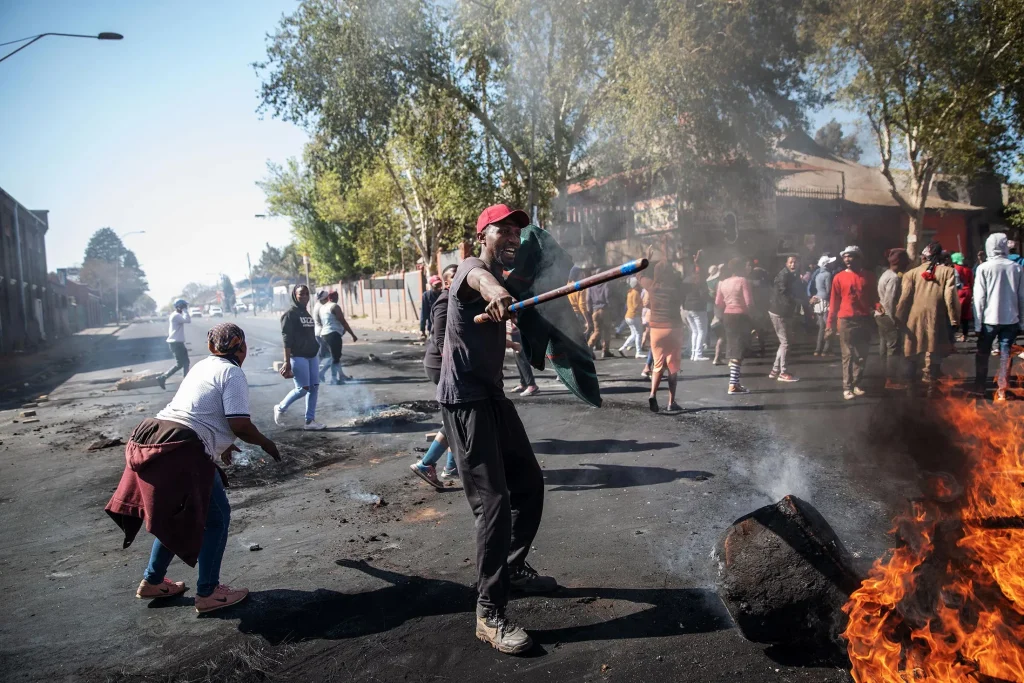
Early this month, the argument was made that xenophobic violence in South Africa is not accidental. The events of the past week have only reinforced that position. Once again, images and reports have emerged of foreign-owned shops looted, businesses burnt, and migrants forced into hiding. Once again, explanations have followed—unemployment, crime, undocumented migration. But these explanations, repeated over the years, are beginning to sound less like analysis and more like excuses for a problem that has outgrown denial.
The recent attacks, reported in parts of Gauteng and KwaZulu-Natal, follow a pattern that is now deeply familiar. Groups of local residents mobilise, sometimes spontaneously, sometimes through organised campaigns, and target businesses owned by foreigners. The victims are often small-scale traders—people who operate within South Africa’s informal economy, selling groceries, running salons, or managing neighbourhood convenience stores.
In many cases, these businesses are not just sources of livelihood for their owners. They are also part of local supply chains. They provide goods at competitive prices, extend informal credit to customers, and, in some instances, employ South Africans. When they are attacked, the damage is not limited to the individual. Entire communities feel the impact.
READ ALSO: Kwara 2027: Femi Sanni Picks APC Nomination Forms
What is different this time is not the violence itself, but the tone surrounding it. There is a growing sense that anti-foreigner sentiment is becoming more openly expressed and, in some quarters, more accepted. Campaigns against undocumented migrants have gained visibility, with some groups framing their actions as a defence of economic rights rather than acts of exclusion.
That shift in language matters. It suggests that xenophobia is moving beyond isolated outbreaks and into something more sustained. It is becoming part of a broader conversation about identity, belonging, and access to economic opportunity in South Africa.
At the heart of the issue remains the country’s unresolved economic crisis. South Africa is one of the most unequal societies in the world. Unemployment remains high, particularly among young people. Many communities continue to struggle with poverty, limited access to services, and a lack of economic mobility. These conditions create frustration, and frustration often looks for a target.
Foreign nationals, especially those who are visible in local economies, become convenient targets. They are seen as competitors, sometimes as outsiders who have succeeded where locals have not. This perception is not always grounded in reality, but it is powerful enough to shape behaviour.
For Nigerian nationals, the situation is particularly delicate. Over the years, Nigerians in South Africa have built a strong presence in sectors such as retail, entertainment, and professional services. At the same time, negative stereotypes—often exaggerated—have contributed to a perception problem. In moments of provocations, these perceptions can quickly translate into hostility.
The economic consequences of the latest attacks are immediate. Businesses are destroyed, goods are lost, and livelihoods are disrupted. For those affected, recovery is not guaranteed. Many operate without insurance or formal protection, making it difficult to rebuild after an attack.
But the impact goes beyond individual losses. There is a broader question of investor confidence. African investors, including Nigerians, have increasingly looked to South Africa as a destination for expansion. Repeated incidents of violence introduce uncertainty into that calculation. They raise questions about safety, stability, and the ability of the country to protect investments.
This has implications for intra-African trade. The African Continental Free Trade Area is built on the idea of reducing barriers and encouraging the movement of goods and services across the continent. But trade is not only about agreements; it is about trust. When businesses feel unsafe, they are less likely to invest, less likely to expand, and less likely to engage across borders.
The diplomatic dimension of the crisis is already unfolding. Nigeria has again expressed concern over the safety of its citizens. Statements from officials have called for protection and concrete action from South African authorities. There are ongoing engagements between both countries, reflecting an attempt to manage the situation without escalating tensions.
Other African countries have reacted in similar ways, though often more cautiously. Zimbabwe, Mozambique, and Malawi—countries whose citizens are frequently affected—face a difficult balancing act. On one hand, they must respond to domestic outrage. On the other, they rely on economic ties with South Africa, including remittances from their nationals working there.
This creates a pattern of measured responses—strong enough to signal concern, but restrained enough to avoid diplomatic fallout. It is a delicate equilibrium, one that underscores the complexity of Africa’s internal relations.
The South African government has responded in predictable terms. Officials have condemned the attacks, emphasised that violence is unacceptable, and reiterated the need to respect the rule of law. Security forces have been deployed to affected areas, and there have been assurances that those responsible will be held accountable.
Yet, as in the past, the effectiveness of these measures remains in question. Arrests may occur, but prosecutions are often slow. Convictions are rare. The result is a cycle in which perpetrators do not face meaningful consequences, and the deterrent effect of law enforcement is weakened.
While the government officially condemns xenophobia, public discourse sometimes sends mixed signals. Discussions about tightening immigration controls or prioritising citizens in economic opportunities can be interpreted in ways that reinforce anti-foreigner sentiment.
This does not mean that such discussions are invalid. Every country has the right to manage its borders and address unemployment. The problem arises when these conversations are not carefully framed, allowing them to feed into narratives that blame foreigners for structural problems.
The broader implications of the crisis extend beyond South Africa. At a continental level, xenophobic violence challenges the idea of African unity. It raises questions about how deeply the principles of Pan-Africanism are embedded in contemporary policy and society.
Africa’s history is built on solidarity. Countries supported one another in struggles against colonialism and apartheid. Nigeria, in particular, played a significant role in supporting South Africa’s liberation. That history is often invoked in moments like this, not as a demand for repayment, but as a reminder of shared values.
The persistence of xenophobia suggests that those values are under strain. Economic hardship, political pressure, and social change have created conditions in which solidarity is no longer taken for granted.
Globally, the situation affects how South Africa and by extension, Africa is perceived. South Africa positions itself as a key destination for investment and a gateway to the continent. Repeated incidents of violence complicate that narrative. They raise concerns about stability and governance, factors that are critical for attracting and retaining investment.
What is perhaps most concerning about the latest attacks is the sense of repetition. The same patterns, the same explanations, the same responses. Each time, there is outrage. Each time, there are promises of action. And each time, the underlying issues remain unresolved.
Breaking this cycle requires more than immediate interventions. It requires a deeper commitment to addressing the structural drivers of xenophobia. Economic reform is central to this effort. Reducing inequality, creating jobs, and expanding opportunities are essential steps in reducing the frustration that fuels hostility.
There is also a need for consistent political leadership. Leaders must be clear in their communication, rejecting xenophobia without ambiguity. They must avoid language that can be interpreted as scapegoating and instead focus on solutions that address the root causes of economic and social challenges.
Law enforcement must be strengthened, not just in response to violence, but in preventing it. This includes intelligence gathering, community engagement, and swift prosecution of offenders. Without accountability, the cycle of violence will continue.
For countries like Nigeria, the response must be both firm and strategic. Protecting citizens abroad is a priority, but so is maintaining diplomatic engagement. The relationship between Nigeria and South Africa is too important to be reduced to periodic crises.
There is also a role for regional and continental institutions. The African Union can provide a platform for dialogue and coordination, helping to address the issue at a broader level. Xenophobia is not just a South African problem; it is an African challenge that requires collective attention.
In the end, the renewed attacks are a reminder that the problem has not gone away. It has simply evolved. The factors that drive xenophobia which are economic inequality, political rhetoric, social perception still present. In some cases, they have intensified.
Understanding this reality is the first step. The next is action—sustained, deliberate, and focused on long-term solutions. Without that, the cycle will continue, and each new wave of violence will further erode the ideals of unity and cooperation that Africa has long aspired to uphold. The question is no longer whether xenophobic violence will occur again. It is whether anything will be done to prevent it.
Alabidun is a media practitioner and can be reached via alabidungoldenson@gmail.com


