


Why Always Rivers State?
By Alabidun Shuaib AbdulRahman
Why is it always Rivers State? The question no longer sounds rhetorical. It has become a recurring reflection whenever Nigeria’s democracy appears strained, its institutions weakened, or its constitutional boundaries tested. Since the return to civil rule in 1999, Rivers State has repeatedly found itself at the centre of political crises that transcend ordinary electoral competition. What distinguishes Rivers is not merely the frequency of conflict, but the intensity, longevity and national implications of those crises. From succession battles to legislative breakdowns and federal intervention, the state has functioned as a pressure point where the contradictions of Nigerian democracy are most vividly exposed.
Rivers State’s peculiar trajectory cannot be understood without acknowledging its strategic importance within Nigeria’s political economy. As one of the core oil-producing states in the Niger Delta, Rivers hosts major petroleum assets that are critical to national revenue generation. Control of the state government therefore carries implications that extend far beyond its borders. Political office in Rivers confers access to enormous fiscal allocations, discretionary power over contracts and appointments, and leverage within national party structures. In a political system where state power is often personalised and monetised, such advantages raise the stakes of political competition to extraordinary levels.
From the onset of the Fourth Republic, these dynamics shaped the character of politics in Rivers. Peter Odili’s administration, which ran from 1999 to 2007, coincided with Nigeria’s democratic reawakening after prolonged military rule. His government helped stabilise civilian authority in the state and strengthened the Peoples Democratic Party’s dominance. Yet it also entrenched a culture of elite patronage that blurred the line between party loyalty and state ownership. Power became concentrated around the executive, while institutions that should have acted as counterweights remained weak. By the time Odili left office, Rivers politics had developed a reputation for fierce internal rivalry masked by outward party unity.
READ ALSO: “You Will Never Walk Alone,” CDS Assures Troops of Improved Welfare
The crisis surrounding the 2007 governorship election revealed the fragility beneath that surface. Celestine Omehia’s short-lived tenure, terminated by a Supreme Court judgment that installed Chibuike Rotimi Amaechi on 25 October 2007, underscored how political outcomes in Rivers were increasingly determined by judicial intervention and party machinations rather than popular participation. While the court’s ruling was constitutionally grounded, it reinforced public perceptions that voters were peripheral actors in a system dominated by elite bargaining.
Amaechi’s eight years in office were among the most turbulent in the state’s history. Initially a key figure within the PDP, he later became a leading opposition voice against the party’s national leadership, particularly during the administration of President Goodluck Jonathan. His defection to the All Progressives Congress ahead of the 2015 elections transformed Rivers into a frontline state in Nigeria’s emerging two-party contest. Elections during this period were marked by violence, legal disputes and allegations of widespread irregularities. Rather than strengthening democratic norms, political competition in Rivers became increasingly militarised and litigious.
The ascension of Nyesom Wike to the governorship in 2015 represented both continuity and escalation. A former ally of Amaechi who became his fiercest rival, Wike governed with an assertive style that left little room for dissent. His administration pursued ambitious infrastructure projects and positioned Rivers as a visible development hub in the South-South. However, these achievements existed alongside an aggressive consolidation of political control. Party structures, legislative independence and local government autonomy were subordinated to the governor’s authority. Politics in Rivers became highly personalised, with loyalty to the executive serving as the principal currency of survival.
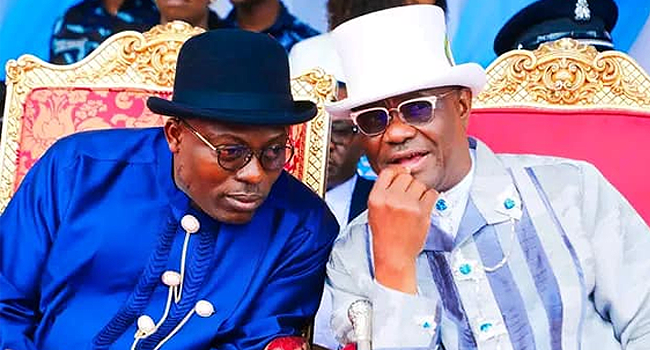
By the end of his second term in 2023, Wike had transcended state politics. His influence within the PDP and later his alignment with President Bola Tinubu elevated him into the national power equation. This context made the question of succession in Rivers unusually consequential. The emergence of Siminalayi Fubara as governor following the March 2023 election was widely interpreted as an extension of Wike’s political will. Fubara’s victory, secured with over 300,000 votes, appeared to confirm the durability of that arrangement.
Yet, Rivers’ history suggested that such successions are rarely seamless. Within months of assuming office, Fubara’s relationship with his predecessor deteriorated sharply. Disagreements over appointments, control of party structures and the autonomy of the executive quickly escalated. By October 2023, the conflict had spilled into the open, culminating in the burning of the Rivers State House of Assembly complex on 29 October. The symbolism of that event was unmistakable: the physical destruction of the legislature mirrored the collapse of constitutional order in the state.
What followed was an unprecedented institutional crisis. The Rivers State House of Assembly split into rival factions, each claiming legitimacy and producing contradictory resolutions. Impeachment proceedings were initiated and countered. Court orders multiplied, often conflicting, while governance ground to a halt. For months, Rivers effectively operated without a coherent legislative authority. This paralysis was not rooted in ideological disagreement or policy failure but in a struggle over political supremacy between a sitting governor and a former one determined to retain influence.
The depth of the crisis prompted federal intervention. On 18 March 2025, President Bola Tinubu declared a state of emergency in Rivers State, suspending the governor, his deputy and the entire House of Assembly for six months and appointing a sole administrator. The federal government cited political paralysis and threats to oil infrastructure, including incidents of pipeline vandalism, as justification. The National Assembly endorsed the proclamation, giving it legal force despite intense public debate.
This intervention marked a watershed moment in Nigeria’s post-1999 constitutional practice. Unlike previous emergency declarations, particularly the 2013 emergency in the northeast, the Rivers action involved the suspension of elected officials. Legal scholars and civil society organisations questioned its constitutional basis, noting that the 1999 Constitution outlines specific procedures for removing governors and legislators. The episode exposed unresolved ambiguities within Nigeria’s federal system and demonstrated how state-level political breakdowns can invite sweeping federal responses.
When the emergency rule was lifted in September 2025 and the suspended officials reinstated, Rivers returned to civilian governance, but the episode left enduring scars. Institutional credibility had been damaged, public confidence weakened and constitutional norms tested. The crisis projected the extent to which Rivers’ political instability had moved beyond internal party disputes to become a national concern.
The persistence of crisis in Rivers is not coincidental. It reflects structural weaknesses embedded within Nigeria’s democratic framework. The concentration of economic resources elevates political competition into a zero-sum contest. Godfatherism distorts succession, turning governance into a continuation of private power struggles. Political parties function less as democratic platforms and more as instruments of elite control. Legislatures and courts, rather than serving as independent arbiters, are drawn into factional battles. In such an environment, stability becomes fragile and crisis recurrent.
The consequences for governance are profound. Political paralysis disrupts budgetary processes, delays development projects and diverts attention from pressing social challenges. Despite its wealth, Rivers continues to struggle with unemployment, environmental degradation and infrastructural gaps. Citizens bear the cost of elite conflict through weakened service delivery and diminished trust in democratic institutions.
Why, then, does it always seem to be Rivers State? Because Rivers has become a concentrated expression of Nigeria’s unresolved democratic contradictions. It is a state where economic abundance coexists with institutional fragility, where political power is personalised, and where succession is treated as conquest rather than continuity. Until these underlying conditions change, Rivers will continue to oscillate between governance and crisis.
The lesson Rivers offers Nigeria is sobering. Democracy cannot be sustained by elections alone. Without strong institutions, internal party democracy and a political culture that respects constitutional boundaries, electoral victories become triggers for conflict rather than mandates for governance. Rivers State stands as a reminder that when politics is reduced to personal dominance, instability becomes inevitable. Until the structures that reward godfatherism and weaken institutions are dismantled, the question will persist, echoing across election cycles and administrations: why is it always Rivers State?


