As G20 Moves On Without America
 0
0
 0
0
As G20 Moves On Without America
By Alabidun Shuaib AbdulRahman
When the G20 summit convened this November in Johannesburg, the first time the gathering has ever been held on African soil, one seat was starkly empty. The world’s largest economy, the Donald J. Trump-led United States, simply refused to attend. No president, no senior envoy, not even a delegation. The absence was louder than any diplomatic communiqué, a void that hung over the proceedings like an unspoken challenge.
For weeks before the summit, Trump had telegraphed the boycott. He announced that no U.S. official would participate, calling it “a total disgrace” that the gathering was being hosted in South Africa. He justified the walkout with allegations that Pretoria was enabling abuses against its white-minority Afrikaner community and presiding over land seizures and a supposed “white genocide”—claims widely rejected within South Africa and dismissed by many global observers. Still, he held to his stance, ensuring that the United States would be missing from the table it once dominated.
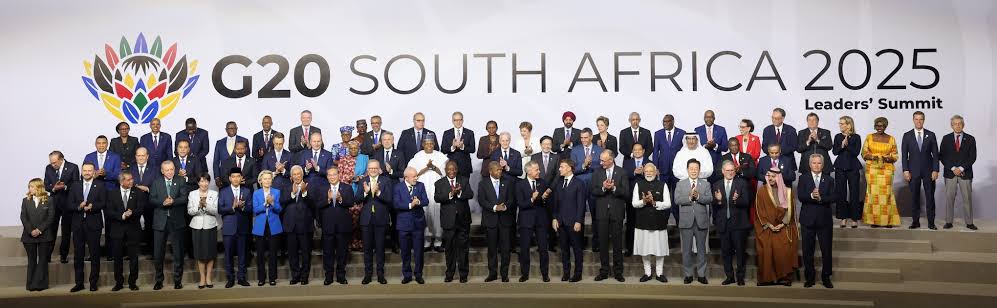
Yet the empty chair did not halt the summit. Far from it. When the doors closed and the work began, more than forty countries and organisations had confirmed their participation. According to South Africa’s foreign-affairs minister, a total of forty-two delegations were registered: twenty G20 member states (excluding the U.S.), sixteen invited guest nations, and six representing regional economic blocs across Africa, the Caribbean and East Asia. It was one of the most diverse gatherings in the forum’s history.
READ ALSO: General Buba’s Death and Our Debt to the Military, by Farooq A. Kperogi
Of the twenty G20 member states, a clear majority sent their heads of state or government. Four countries opted for high-level substitutes: Russia, Mexico and Argentina sent their foreign ministers or equivalents, while China was represented by its Premier rather than President Xi Jinping. Apart from these deviations and the complete American boycott, the turnout remained strong. At least sixteen G20 countries had their top leadership present, a level consistent with or even above several previous summits.
The question, then, is what this moment signifies—for the G20, for Africa’s place in global governance, and for a world increasingly shaped by fractured geopolitics.
The symbolic dimension is impossible to ignore. For decades the United States has been the gravitational centre of global economic coordination, the anchor whose participation guaranteed that G20 pronouncements could be translated into global action. Without Washington in the room, many of the traditional levers of influence like financial stability mechanisms, trade dynamics, institutional power felt looser and less predictable. The absence introduced doubt: could the G20 still claim to be the premier platform for steering the global economy if its most powerful member stayed away? Some analysts wondered whether the forum’s future was in jeopardy.
Yet paradoxically, the boycott created breathing space. Instead of collapsing under the weight of American non-participation, the summit moved forward with surprising cohesion. Leaders adopted a 122-point declaration issued unusually on the summit’s opening day that centred on climate action, debt sustainability, energy transition and global inequality. These were not peripheral concerns but core priorities, particularly for developing economies. And critically, they reflected Africa’s agenda far more directly than in past years.
For Africa, a continent long relegated to the fringes of global decision-making, the Johannesburg summit brought a subtle but significant shift. It marked a moment where issues that have shaped African suffering and aspiration, unsustainable debt, climate vulnerability, access to green energy, development finance were not treated as charity cases or footnotes but as global imperatives. South Africa’s leadership in shaping the agenda was evident: it shepherded conversations that placed the continent not as a crisis zone but as a partner with agency.
Even the ending of the summit carried symbolism. The traditional handover of the G20 presidency, typically marked by the passing of a wooden gavel from one host to the next, did not unfold in its usual choreography. President Cyril Ramaphosa brought the meeting to a close with a strike of the gavel, but there was no American official to step forward and receive the ceremonial baton. The moment underscored the deeper reality: the world’s most powerful nation had chosen absence in a year when Africa chose presence.
Naturally, this raised concerns. If powerful states begin treating multilateral forums as optional, depending on domestic politics or ideological sentiments, the foundations of global governance weaken. The G20 has played central roles in navigating financial crises, stabilising commodity markets, coordinating pandemic responses and mobilizing climate finance. A precedent where a superpower boycotts the summit could encourage similar behaviour by others in future moments of crisis. The potential ripple effects on global trust, crisis management and economic coordination are worrying.
But Johannesburg also demonstrated that the G20 is more adaptable than its critics assume. Instead of paralysis, the summit produced consensus. Instead of division, it surfaced shared interests. And instead of waiting for the United States to validate decisions, countries across continents showed that cooperation was still possible, even necessary, without America’s guiding hand.
For many African nations, this sense of possibility was palpable. For years, they have been the subjects of global policies drafted in distant capitals. In Johannesburg, they felt more like contributors. The declaration reflected structural concerns that matter from Lagos to Nairobi: access to concessional finance, green industrialization, fair energy transition pathways, investment in resilience rather than repeated cycles of vulnerability. These were not afterthoughts but central pillars.
Still, optimism should remain grounded. Declarations alone do not build roads, transition energy grids or relieve debt burdens. They do not shift the voting power held by wealthy nations in global financial institutions. And they do not erase the influence the United States wields over the IMF, World Bank and other structures that control the flow of global capital. Even in absence, Washington’s shadow is long.
At the same time, the boycott raises uncomfortable questions about the future. If summits can be walked away from because of domestic political narratives or ideological disagreements, the global architecture becomes more fragile. Future crises, whether debt shocks, pandemics, food shortages or climate-induced disasters require collaboration and not boycotts. A forum that can be abandoned sets troubling precedents.
Yet this moment may also become a hinge in history. Not because it solves everything, but because it marks a shift in rhythm. It shows the system bending, under pressure, toward greater inclusion. It proves that Africa can host, convene and even lead. More than nineteen members signed the declaration; voices from the Global South resonated with unusual clarity. And for once, those who are often asked to wait for the powerful to decide had already begun making decisions of their own.
For Nigeria, the implications are profound. The global conversation is moving toward issues that directly affect its development path: debt restructuring, climate resilience, green industrial transformation, food security and transparent governance. Nigeria must engage with these shifts deliberately. Declarations will mean little if national policy fails to align with them. The country needs bold investments in climate adaptation, expanded support for agriculture and manufacturing, improved fiscal management and stronger accountability mechanisms. Its diaspora and civil society have roles to play as watchdogs, advocates and bridges linking global promises to local action.
The United States will remain central in global affairs. Its currency, markets and institutional power ensure that. But the Johannesburg summit demonstrated something important: relevance in the G20 is no longer solely measured by presence. Sometimes absence reshapes the conversation more than participation. The empty chair at Johannesburg was not just a diplomatic symbol; it became a catalyst for rethinking old assumptions.
The challenge now is to ensure that the space created by that absence is not wasted. The real measure of success will lie in implementation in whether climate justice initiatives become real funding pipelines, whether debt deals become fairer, whether green energy investments materialise, and whether global decisions begin to reflect the needs of people from Kenya to Ghana, rather than only those in United States or Germany. It will lie in whether African leaders rise to the occasion, using the moment to insist on equity rather than settling for symbolism.
The world watched as the G20 pressed on, limping perhaps, but moving. And Africa did more than host; it spoke, it influenced, it guided. If Nigeria and the rest of the continent seize the momentum, the reverberation of that gavel strike in Johannesburg could echo not only through global institutions but through local communities seeking fairness and development.
In the end, the empty seat left behind by the United States did not define the summit. The G20 may not have needed America to agree on a declaration in 2025. But building a future that transcends absence will require a different kind of presence.
If Africa answers that call, history may yet record that the empty chair marked not a failure, but the beginning of something new.
Alabidun is a media practitioner and can be reached via alabidungoldenson@gmail.com