Nigeria’s Growing Begging Economy, by Farooq A. Kperogi
 0
0
 0
0
Nigeria’s Growing Begging Economy, by Farooq A. Kperogi
As the economy bites harder and end-of-year festivities rev up, the routine “tax” on middle-class Nigerians (the few of them that still exist, that is,) the political class and Nigerians in the diaspora predictably intensifies.
December is always expensive in Nigeria, but it now comes with an additional, informal levy: the expectation that anyone perceived as doing “well” must redistribute their resources far beyond family obligation.
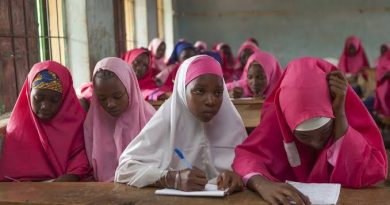
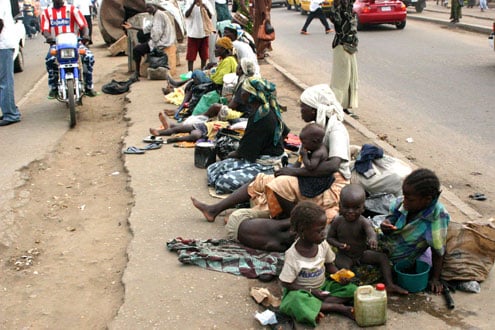
For a long time, begging in Nigeria was associated with what Marxists once called the lumpen proletariat, that is, the dirt-poor, socially marginal and largely unorganized underclass. In Nigeria, this image was most vividly represented by the almajirai in the North, children sent to Qur’anic schools who were expected to fend for themselves through street begging.
That picture no longer captures the reality. Begging has morphed into a flourishing, multi-layered industry with widening entrants, diversified platforms and increasingly normalized practices. What was once stigmatized has become routinized, rationalized and, in some cases, even celebrated.
One major accelerant of this shift is online begging, or e-begging. It first gained social legitimacy through “giveaways” staged by social media influencers seeking to grow the numerical strength of their subscriber base and boost engagement metrics. What began as a marketing tactic quickly turned into a cultural script. The logic is that public generosity creates visibility, visibility creates clout and clout converts to income.
READ ALSO: IEDPU FCT Felicitates Saraki on Birthday
But the giveaways did something more corrosive. They normalized public solicitation. Today, hordes of Nigerians drop their names and bank account numbers in comment sections without the slightest embarrassment. Sometimes they do so during announced giveaways. Increasingly, they do so even when there is no giveaway at all. The request itself has become the performance.
This represents a sharp cultural break. Shame and moderation, once important moral regulators in many Nigerian societies, have been eroded. Mendicancy has shed its stigma. Asking publicly for money, repeatedly and without restraint, no longer attracts social penalty. In some online spaces, it attracts admiration for “boldness.”
To be clear, taxing wealthier relatives to feed, clothe and educate poorer kin is not new. Many Nigerians from economically deprived homes benefited from the kindness and generosity of more successful relatives. I am one of them.
We also learn that when we climb the ladder, we have a moral obligation to pay it forward. This ethic of mutual aid is deeply embedded in many Nigerian cultures, and it has helped countless people survive in the absence of a functional welfare state.
What has changed is not the ethic itself but its scale, scope and coercive intensity.
In the last few years, driven by rising inequality and the normalization of begging as an income strategy, the financial and emotional burden placed on comparatively well-off professionals has widened dramatically. The obligation now extends well beyond extended family. Acquaintances, friends of friends, former classmates, distant community members and even strangers now feel entitled to private redistribution.
Worse still, not everyone whose burden is carried by others is poor. For many, begging has become a source of passive income, an alternative revenue stream or even the primary means of livelihood. I have heard multiple accounts of people who built entire houses, from foundation to finishing, purely from proceeds of beggary. This is no longer emergency relief. It is enterprise.
What sustains this culture is a peculiar sense of entitlement. For example, Nigerians who live abroad, especially in countries with stronger currencies, are widely imagined to be awash in vast oceans of money.
The brutal realities of rent, taxes, health insurance, childcare and precarious labor markets abroad are erased. They conveniently replace the lived experience of diasporan Nigerians with a crude, ignorant exchange-rate arithmetic.
As a result, even acts of real sacrifice are interpreted not as generosity but as sprouting from effortless abundance.
I once extended a significant financial favor to a relative. Instead of gratitude, I later learned that this person had told another relative that I did not deserve too much praise because the dollar-to-naira exchange rate meant that “a few thousand dollars” from me amounted to millions of naira. The assumption was that thousands of dollars are to Americans what thousands of naira are to Nigerians.
This is fantasy economics, of course, but it is powerful fantasy. It turns helpers into inexhaustible wells. Nothing they give is ever enough because the imagined surplus is infinite.
Politicians and people close to political power experience the same dynamic. Merely being adjacent to authority is enough to generate demands. People assume access to limitless resources, contracts, favors and cash. Every refusal is read as “wickedness.” Every gift is insufficient. Gratitude disappears because entitlement has taken its place.
What makes this phenomenon especially troubling is that it is rarely recognized as structural. It is personalized, moralized and weaponized. If you resist, you are accused of selfishness or betrayal. If you comply, you’re seen as embodying boundless abundance, and the demands escalate. Either way, the individual absorbs the costs of collective failure.
There is no question that the scale and persistence of begging are increasing daily in Nigeria. Previously proud and self-respecting people now engage in what can only be described as executive begging: polished, strategic, emotionally manipulative solicitation performed by people who know exactly how to frame vulnerability for maximum extraction.
Unfortunately, this is not a victimless system. Fairly well-to-do Nigerians, both at home and abroad, are stretched and stressed. They are not simply “helping family.” They are informally tasked with carrying portions of the nation’s social welfare burden. They subsidize state collapse with private sacrifice. But no seems to know or care.
The consequences are profound. Many delay building their own homes. Others postpone retirement savings. Some abandon entrepreneurial ambitions. Intergenerational wealth transfer becomes impossible when today’s surplus is permanently pre-empted by yesterday’s deprivation. What looks like generosity in the short term reproduces fragility in the long term.
This is why the phenomenon deserves systematic study. How much is the begging economy worth annually in Nigeria? What proportion of household income flows through informal redistribution networks? How much investment, savings and productive capital formation is foregone as a result? Until we quantify these questions, we will continue to treat a structural crisis as a series of private moral dilemmas.
Individualizing a structural problem harms everyone. It breeds resentment among givers, dependency among receivers and moral confusion in society at large. We end up with a culture where no one feels responsible for fixing institutions, but everyone feels entitled to someone else’s paycheck.
Nigeria needs a system where the burden of state failure is not casually transferred to individuals lucky enough to escape it. We need social norms that reward productivity and dignity rather than permanent solicitation. We need public policy that reduces desperation instead of romanticizing survivalism. Most of all, we need to recover the idea that begging should be a last resort, not a business model.
Until then, Nigeria’s growing begging economy will continue to expand, insidiously taxing the few who manage to stay afloat while deepening the very inequalities that made it possible in the first place.