ADC and Its House of Confusion
 0
0
 0
0
ADC and Its House of Confusion
By Alabidun Shuaib AbdulRahman
In the space of a few days, the African Democratic Congress, ADC has managed to compress into itself the full drama of Nigeria’s party politics involving elite bargaining, judicial intervention, strategic defections, and the ever-present shadow of electoral deadlines. What should have been a defining moment for a party positioning itself as the nucleus of a broad opposition coalition ahead of 2027 has instead become a study in instability. The ADC today is not merely in crisis; it is in a state of suspended legitimacy.
The roots of the present turmoil can be traced to the ambitious political engineering that began in 2025, when the party’s founding leadership led by Ralph Okey Nwosu ceded control to a new power bloc designed to attract heavyweight politicians across party lines. The arrangement brought in former Senate President, David Mark as National Chairman and former Osun State governor, Rauf Aregbesola as National Secretary. The idea was straightforward: rebrand the ADC into a credible “third force” capable of uniting disparate opposition figures, including former Anambra State governor and the Labour Party presidential candidate in 2023, Peter Obi, ex-Kaduna governor Nasir El-Rufai, and other influential actors disenchanted with both the ruling party and the existing opposition structure.
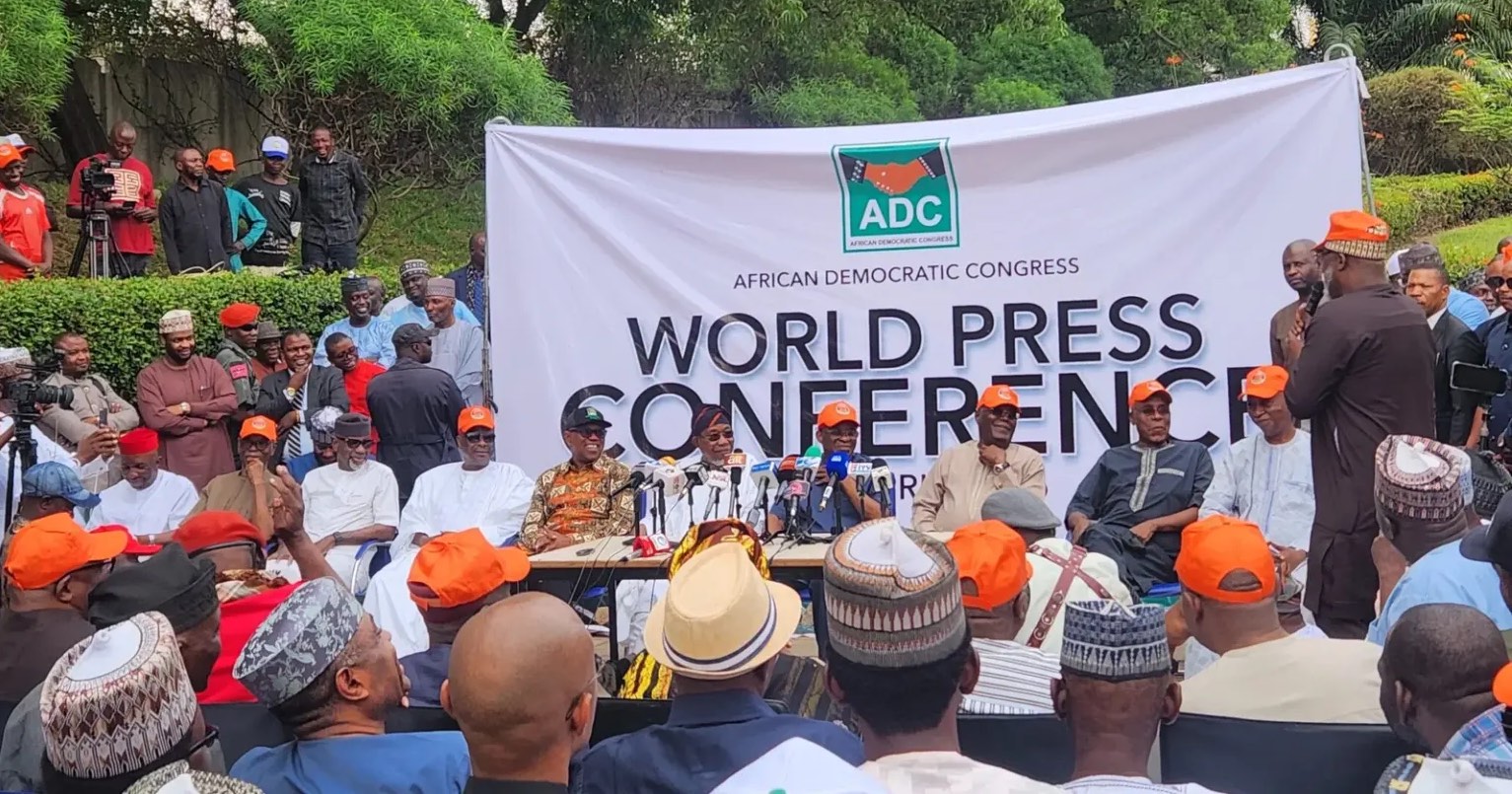
For a brief moment, the strategy appeared to be working. Meetings were held in Abuja and Lagos throughout late 2025 and early 2026, with coalition talks reportedly involving figures such as former Rivers State governor, Rotimi Amaechi, former Sokoto State governor, Aminu Tambuwal, and ex-Senate President, Bukola Saraki. Though not all formally joined the ADC, the party became the focal point of negotiations around a possible mega opposition platform. The optics alone elevated its status in national discourse.
READ ALSO: From One Degree to Four: How Ilorin-born Muhammed Olorunoje Defied Stereotypes to Earn UK Honours
But coalition politics in Nigeria has a well-documented vulnerability: it often prioritises elite consensus over institutional clarity. The ADC’s leadership transition, while politically expedient, lacked the procedural rigour necessary to withstand internal contestation. Almost immediately, dissenting voices within the party began to question the legality of the handover, arguing that due process as stipulated in the party constitution had not been fully observed.
This internal disagreement escalated into litigation, with factions approaching the Federal High Court in Abuja to challenge the legitimacy of the Mark-led leadership. The situation became more complicated when conflicting orders emerged from different courts, a familiar pattern in Nigeria’s political jurisprudence. At one point, a Court of Appeal ruling imposed a “status quo ante bellum” order, effectively freezing the leadership structure as it existed before the contested transition.
That order, however, did not settle the matter; it deepened the confusion. Both factions interpreted the ruling in ways that favoured their positions, leading to parallel claims of authority. Party activities slowed to a near halt, as uncertainty over who legitimately controlled the ADC made it difficult to convene meetings, conduct congresses, or engage meaningfully with the Independent National Electoral Commission, INEC.
The turning point, if it can be called that, came on April 30, 2026, when the Supreme Court intervened. In a judgment delivered in Abuja, the apex court set aside the Court of Appeal’s status quo order and directed that the substantive case be returned to the Federal High Court for determination. The ruling was immediately seized upon by the Mark-Aregbesola faction as validation of their leadership, while their opponents insisted that the court had merely removed an interim order without deciding the core issue.
Legally, as a Lawyer friend argued, the latter interpretation is closer to the truth. The Supreme Court did not pronounce on who leads the ADC; it addressed only a procedural question. By vacating the preservative order, it reopened the space for the Mark-led executives to function, but it left the substantive dispute unresolved. In practical terms, the party now operates in a grey zone, neither fully validated nor definitively invalidated.
This ambiguity could not have come at a worse time. Nigeria’s electoral cycle, though seemingly distant from 2027, is already in motion. The Independent National Electoral Commission, INEC requires political parties to adhere to strict timelines, beginning with the submission of updated membership registers and culminating in the nomination of candidates. While INEC has yet to release the full timetable for the 2027 general elections, precedents from previous cycles indicate that primaries and candidate submissions typically occur at least a year before the polls.
Under the Electoral Act 2022, particularly Sections 29 and 84, parties must conduct primaries within specified windows and submit their candidates within deadlines that are not subject to extension. Any irregularity in the process, especially one arising from disputes over party leadership can render a candidate’s nomination invalid. Nigerian courts have consistently upheld this principle, as seen in cases involving Zamfara and Rivers states in previous election cycles, where parties lost entire slates of candidates due to procedural defects.
For the ADC, this legal framework presents an existential risk. If the leadership question remains unresolved by the time primaries are due, any exercise conducted by one faction could be challenged by another, leading to protracted litigation that may ultimately disqualify the party from fielding candidates in key elections. This is not a theoretical concern; it is a scenario with ample precedent in Nigeria’s electoral history.
Meanwhile, the political consequences of the crisis are beginning to manifest. High-profile figures who had been linked to the ADC are reportedly reconsidering their options. Peter Obi, whose 2023 presidential bid galvanised a significant youth following, has been cautious in his engagement with the party, mindful of the legal uncertainties. Similarly, Rabiu Musa Kwankwaso and some political bigwigs seen as potential power brokers in any opposition coalition are said to be weighing alternative platforms should the ADC fail to stabilise.
The logic behind these recalibrations is straightforward. Political heavyweights require not just a platform, but a secure one. A party entangled in litigation cannot guarantee ticket security, campaign coherence, or post-election legitimacy. In a system where court judgments often determine electoral outcomes, legal vulnerability is a liability no serious contender can afford.
The irony is that the ADC’s crisis is largely self-inflicted. In its bid to rapidly transform into a coalition platform, it overlooked the slow, painstaking work of institution-building. The absorption of powerful figures was not matched by the creation of mechanisms to manage their competing ambitions. Nor was there sufficient attention to aligning the party’s constitutional framework with the new political realities. The result is a structure that is expansive in ambition but weak in cohesion.
There is also a deeper structural issue at play: the tendency of Nigerian political actors to resort to the courts as the first line of dispute resolution. While judicial intervention is essential in a constitutional democracy, its overuse in intra-party conflicts often leads to prolonged uncertainty. Courts are bound by procedure and timelines that do not always align with the urgency of political processes. As the ADC is now discovering, a case can move through multiple judicial layers without delivering the kind of decisive clarity required for political stability.
Yet, it would be premature to write off the party entirely. The ADC still possesses assets that many smaller parties lack: national visibility, a growing network of political actors, and a narrative that resonates with voters seeking alternatives. If it can resolve its leadership dispute quickly, either through judicial determination or political compromise, it may yet reclaim its position as a viable opposition platform.
Such a resolution, however, will require more than legal victories. It will demand a conscious effort to rebuild trust within the party, clarify its organisational structure, and establish transparent processes for decision-making. The ambitions of key stakeholders such as Atiku Abubakar, Abubakar Malami, Rabiu Musa Kwankwaso, Rotimi Amaechi, Peter Obi, Nasir El-Rufai, and others must be reconciled within a framework that prioritises institutional stability over individual advantage.
The stakes are high, not just for the ADC but for Nigeria’s democratic trajectory. A fragmented opposition benefits the incumbent by default, reducing electoral competition and limiting voter choice. Conversely, a cohesive and credible alternative can energise the political landscape, introduce new ideas, and enhance accountability.
As things stand, the ADC is at a crossroads. One path leads to consolidation and relevance; the other to fragmentation and irrelevance. The difference between the two will be determined in the coming months, as court proceedings continue and political actors make strategic decisions about their futures.
For now, the party remains what it has become over the past few days, ‘a house of confusion’, where legal uncertainty, political ambition, and institutional weakness collide. Whether it can transform that confusion into clarity will not only shape its own destiny but also influence the contours of the 2027 general elections and the balance of power that emerges in their aftermath.
Alabidun is a media practitioner and can be reached via alabidungoldenson@gmail.com