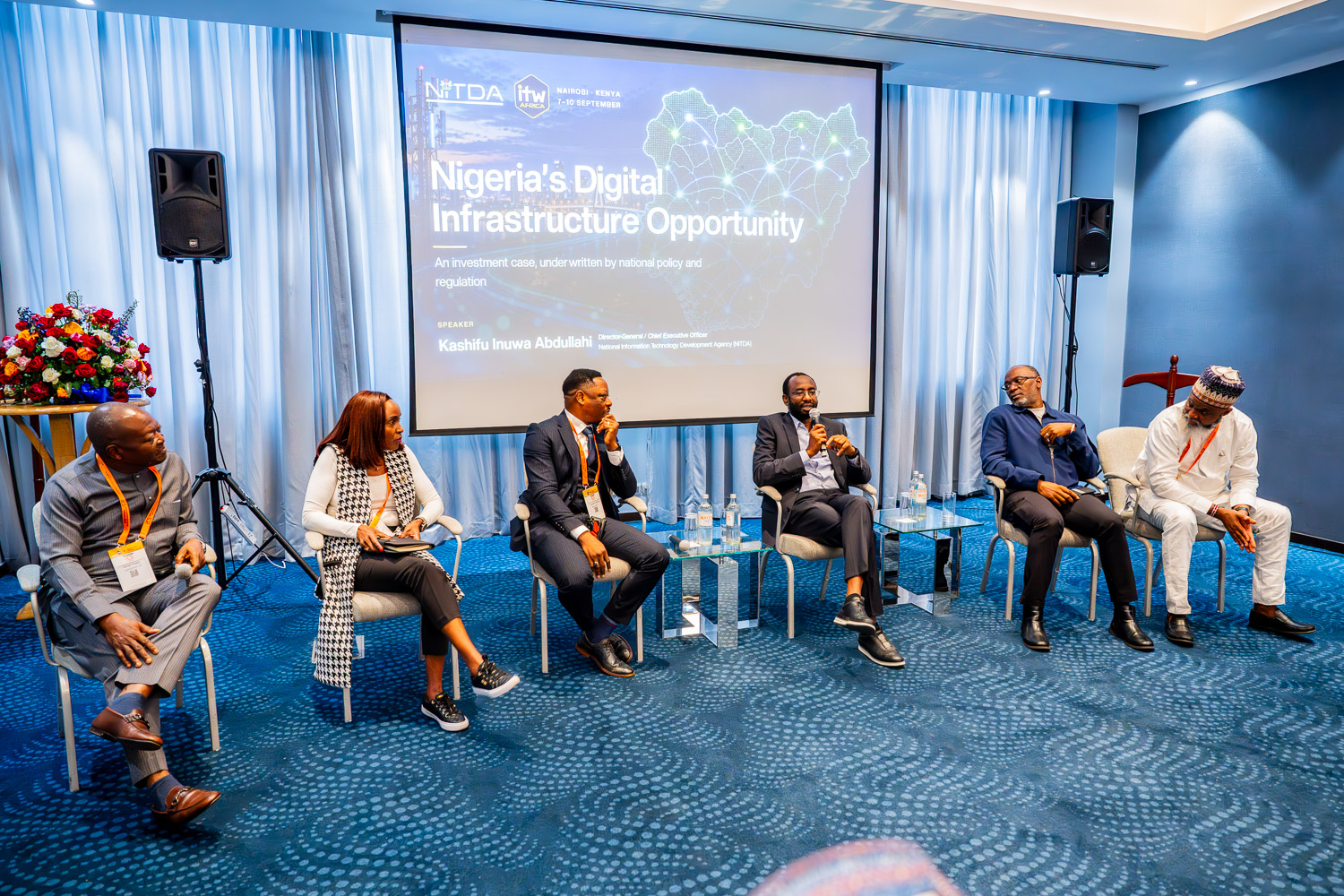
NITDA courts investors with policy certainty, cybersecurity framework
 0
0
 0
0
NITDA courts investors with policy certainty, cybersecurity framework
By Alabidun Shuaib AbdulRahman
The Director-General of the National Information Technology Development Agency, NITDA, Kashifu Inuwa, has said clear government policies and regulatory certainty are critical to attracting more investments into Nigeria’s data centre and digital infrastructure sector.
Inuwa stated this while speaking at a high-level industry panel titled, “Converting Digital Demand into Data Centre Investment,” at the recently concluded ITW Data Cloud Africa 2026.
The panel brought together key industry players, including Ike Nnamani of Digital Realty Nigeria, Wole Abu of Equinix, Temitope Osunrinde of Africa Hyperscalers and Cherotich Kiereini of Oracle.
READ ALSO: ICPC inducts 11 NYSC anti-corruption members
The NITDA boss said Nigeria’s rapidly expanding digital economy presented significant opportunities for investment in data centres, cloud computing and artificial intelligence infrastructure, but stressed that such opportunities could only be fully harnessed through deliberate government policies and a predictable regulatory environment.
According to him, the government’s responsibility is to provide clear strategic direction and establish a stable framework that enables investors and technology operators to make long-term investment decisions with confidence.
Inuwa explained that regulatory certainty would enable investors to understand how digital infrastructure would be developed, governed and utilised, thereby reducing uncertainties associated with major capital investments.
He said, “The primary responsibility of government is to clearly establish strategic intentions, creating a stable framework that not only guides what needs to be built but actively catalyses growth across the tech landscape.”
The NITDA director-general also identified Nigeria’s large and growing digital market as one of its major advantages, noting that the country’s investment potential extended beyond its population.
He said increasing demand for localised digital services and workloads was creating new opportunities for data centre operators and other technology infrastructure providers.
Inuwa further pointed to Nigeria’s geographical position as a potential transit and connectivity hub for West and Central Africa, adding that the country’s growing pool of technology professionals provided another advantage.
He said local technology talent could develop innovative solutions on modern digital networks, positioning Nigeria to play a central role in the region’s digital transformation.
The NITDA boss, however, stressed that security and digital trust must remain central to the development of the country’s digital infrastructure.
He said the agency was strengthening cybersecurity frameworks to ensure that the expansion of digital infrastructure was matched by adequate protection of data, systems and critical national assets.
Inuwa cited the Digital Assurance Framework, the Cybercrime Act and the broader National Cybersecurity Architecture as some of the measures supporting the government’s efforts to strengthen digital trust.
He explained that cybersecurity considerations were increasingly being incorporated into government technology projects from the design stage, with projects subjected to cybersecurity-by-design clearances.
According to him, the approach covers the entire digital ecosystem, ranging from last-mile devices to critical national infrastructure.
He said the combination of policy clarity, regulatory certainty, cybersecurity and industry collaboration would provide the foundation required for sustained investment in data centres, cloud computing and artificial intelligence infrastructure.
Inuwa added that Nigeria’s ability to convert its expanding digital demand into bankable infrastructure projects would depend on sustained collaboration between government, technology companies, investors and other stakeholders.
He said such collaboration would help create an ecosystem capable of supporting the country’s digital economy while also positioning Nigeria as a major technology infrastructure hub in Africa.