


Examining Nigeria’s Health System and Preventable Deaths
By Alabidun Shuaib AbdulRahman
My last week’s column, ‘The Agony of a Columnist,’ was written from a place I never expected to occupy. It was not an attempt at catharsis, nor was it designed to elicit sympathy. It was simply an account of what happened when a citizen encountered the Nigerian healthcare system at its most critical moment and found it wanting. The death of my eight-month-old daughter occurred within a public hospital that, on paper, appeared functional. What followed exposed a gap between appearance and capacity that deserves closer scrutiny rather than sentiment.
This week’s column is broader. It is about structure, policy, and outcomes. It is about what the data says and what lived experience confirms about the state of healthcare delivery in Nigeria, a system that reflects not only underperformance but failure at its most consequential moments.
Considering another recent case that captured national attention, that of Ifunanya Lucy Nwangene, a 25-year-old Abuja-based singer who was bitten by a cobra in her home. She sought emergency care immediately, moving from one health facility to another, and struggled to obtain antivenom and appropriate treatment before it was too late.
READ ALSO: Kwara Reopens Schools as Security Improves
Accounts vary on the specifics, but the tragedy is indisputable. Her death, amid circumstances that could have been preventable, echoes the avoidable loss of my own child and reflects the same systemic weaknesses that place ordinary citizens at risk every day. Reports indicate that approximately half of Nigerian hospitals lack the capacity to manage snakebite cases effectively and that nearly all facilities experience difficulties in administering antivenom, the only treatment recognized by the World Health Organization for venomous bites. Such deficits in treatment capacity, emergency response, essential medicines, and clinical training are not anomalies; they are the predictable outcome of chronic systemic weakness.
Nigeria’s healthcare system is structured across primary, secondary, and tertiary levels. According to the latest facility registry data, there are roughly thirty-eight thousand six hundred forty-five operational health facilities nationwide, a figure that includes both public and private establishments, translating to approximately eleven facilities per one hundred thousand people in a population exceeding two hundred and twenty million. Primary care facilities account for nearly eighty-eight per cent of all facilities, secondary care roughly twelve per cent, and tertiary facilities less than one per cent.
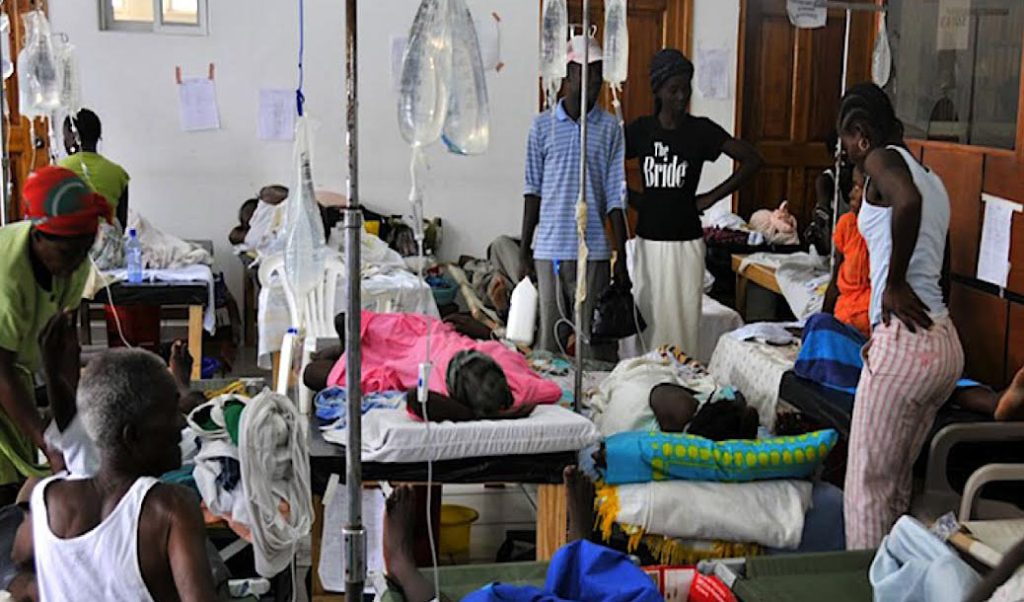
On paper, the distribution seems extensive, but quantity does not equal quality or functionality. The majority of primary healthcare centers, which form the first line of defence, are unable to deliver essential services consistently due to shortages of trained personnel, drugs, water, power, and equipment. Only about twenty per cent of primary facilities are considered fully functional, leaving millions of Nigerians dependent on emergency care that is often delayed or unavailable.
Health outcomes are determined by human resources as much as infrastructure, yet Nigeria’s health workforce is severely strained. The doctor-to-population ratio remains well below the World Health Organization’s recommended threshold of one doctor per six hundred people, with practical estimates ranging from one doctor per four thousand to one per five thousand citizens, and some areas experiencing ratios as low as one per nine thousand eight hundred.
Nurses and midwives are similarly scarce and unevenly distributed, favoring urban centers over rural and peri-urban areas. Absenteeism and burnout are systemic risks exacerbated by poor remuneration, unsafe working conditions, and limited career progression. The migration of trained health professionals abroad not only represents a loss of public investment but reduces the system’s capacity to respond to emergencies, increasing the likelihood that predictable crises result in preventable deaths.
Funding is a primary driver of these gaps. Nigeria is a signatory to the 2001 Abuja Declaration, committing to allocate at least fifteen per cent of annual budgets to health, yet the highest allocation recorded in any year remains below six per cent. By comparison, global benchmarks suggest public health spending should constitute at least five per cent of GDP to achieve basic universal health coverage, while Nigeria currently allocates approximately half a per cent. Per capita health expenditure ranges between ten and fifteen US dollars annually, which is insufficient to ensure functional hospitals, reliable emergency response, or the availability of essential drugs and equipment.
The inadequacy of public funding shifts the burden to households. Out-of-pocket payments account for nearly seventy to seventy-five per cent of total health spending, meaning that patients and families finance care at the point of illness rather than through pooled systems. Less than ten per cent of Nigerians are covered by any functional health insurance, and coverage is largely limited to formal sector employment. As a result, families often delay care, ration treatment, or avoid facilities altogether until conditions deteriorate beyond recovery.
The human consequences of these systemic failures are evident in national health indicators. Nigeria continues to have one of the highest maternal mortality ratios in the world, exceeding eight hundred deaths per one hundred thousand live births, and accounts for approximately twenty per cent of global maternal deaths despite representing less than three per cent of the world population. Infant and under-five mortality remain high, with recent surveys showing roughly sixty-seven deaths per one thousand live births and one hundred and ten per one thousand respectively. Many of these deaths result not from rare or complex conditions but from the inability of the health system to provide timely, skilled intervention for preventable or manageable illnesses. Malaria, pneumonia, childbirth complications, and neonatal distress often escalate into fatalities that could have been avoided had emergency care been available, adequately staffed, and well-supplied.
Infrastructure alone does not solve the problem. Hospitals are renovated, equipment procured, and wards repainted, but functionality depends on staffing, reliable power, water, supply chains, and governance. Electricity supply is particularly critical, as hospitals depend on continuous power for monitoring, oxygen delivery, laboratory diagnostics, and refrigeration of vaccines and essential medicines. Yet many facilities rely on intermittent generators with uncertain fuel supply, leaving patients exposed to system failures that no renovation or new building can correct.
Primary healthcare centers, despite their numbers, are frequently unable to provide preventive and early intervention services, meaning that conditions that should be addressed at the community level escalate to secondary facilities that themselves are overstretched.
Accountability within the health system is diffuse. Budget allocations are announced, but utilization and outcomes are weakly monitored. Staffing requirements are often unmet, and enforcement is inconsistent. Failures rarely attract consequences proportional to their impact, leaving citizens, including vulnerable infants and young adults, to bear the cost. Hospitals are frequently evaluated on the wrong metrics, such as bed count or physical infrastructure, rather than whether care is actually delivered. Time-sensitive emergencies cannot wait for policy announcements or cosmetic compliance; delays and absenteeism in these circumstances are measured in lives lost.
Both my personal experience and the case of the young singer illustrate these realities. My daughter was taken to Suleja General Hospital where initial symptoms did not appear severe, yet she required urgent intervention. Medical review was delayed, oxygen was administered without a definitive diagnosis or treatment plan, and a requested transfer to another facility was not effected in time. In the singer’s case, urgent antivenom administration was critical to survival, yet the system’s gaps prevented timely care, and the result was fatal. These outcomes are not anomalies; they are predictable expressions of systemic failure.
Nigeria does not lack reform frameworks. Initiatives exist to revitalize primary healthcare, expand health insurance, and improve maternal and child health outcomes. Some interventions have produced measurable gains in targeted areas, but they remain uneven and insufficiently scaled, often undermined by governance failures and weak operational oversight. The result is a system that prioritizes form over function, presenting the appearance of readiness while leaving emergency response and routine care vulnerable to failure. The consequences are borne not by policy-makers or administrators, but by citizens whose lives hang in the balance.
The purpose of revisiting last week’s column is not to relive personal grief but to insist on institutional reflection. Every preventable death, whether of a child in a public hospital or a young adult succumbing to a snakebite or otherwise, represents a failure of policy, funding, and governance. Healthcare is not an area where delays, absenteeism, or cosmetic compliance can be absorbed without consequence. Systems either respond, or they fail. In Nigeria, the record shows repeated, predictable failures. Mortality data, budget analyses, facility assessments, and lived experience all converge to the same conclusion: when the health system is tested, it often cannot deliver.
The crisis is visible, documented, and persistent. Nigeria’s hospitals function intermittently, supply chains are fragile, essential medicines are inconsistently available, and health workers are overstretched. Until outcomes, rather than infrastructure announcements, become the primary measure of success, preventable deaths will continue.
Tragically, the cost is measured not only in statistics but in lives that could have been saved. My daughter’s loss was personal, and the death of Ifunanya Nwangene was public. Both expose the same reality: a healthcare system that cannot guarantee timely, competent response in emergencies is not merely underperforming; it is failing its most fundamental obligation.
The reality requires less rhetoric and more reform, less emphasis on appearances and more attention to function. Budget allocations must be credible and linked to measurable outcomes, staffing requirements must be enforced, essential medicines and equipment must be reliably supplied, and emergency systems must be consistently operational. Until these conditions are met, Nigeria will continue to produce tragic but predictable stories of lives lost to systemic weakness, and citizens will continue to confront a healthcare system that appears reassuring until it is tested at its most critical moments.
Alabidun is a media practitioner and can be reached via alabidungoldenson@gmail.com


