


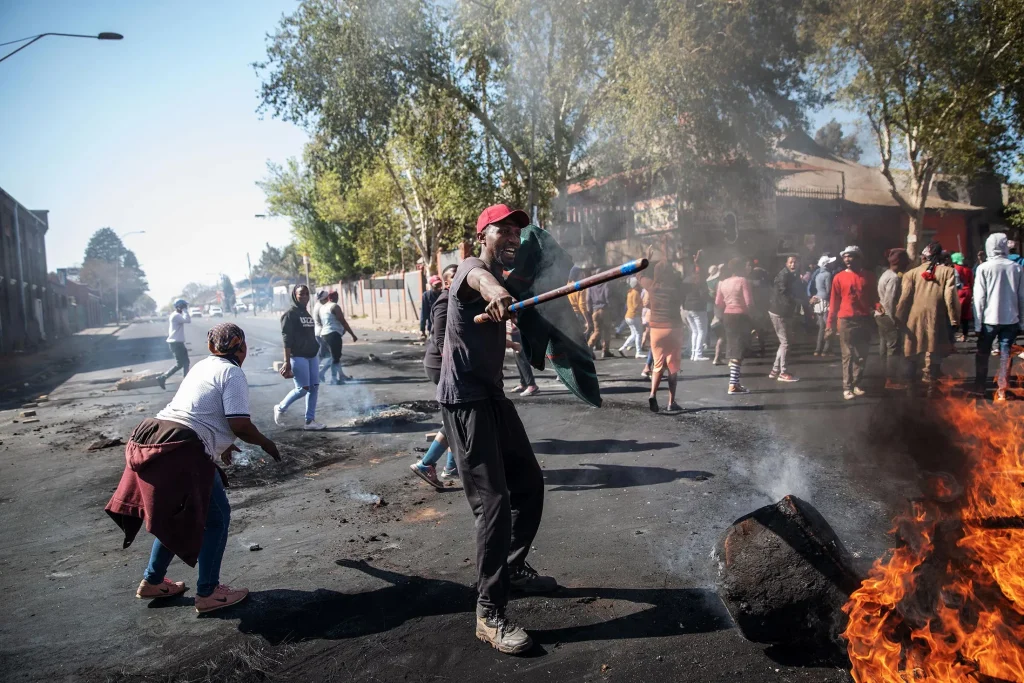
Understanding South Africa’s Xenophobic Violence
By Alabidun Shuaib AbdulRahman
There is a tendency to explain xenophobic violence in South Africa as a spontaneous eruption of anger by frustrated citizens. That explanation is convenient, but it is incomplete. What has unfolded repeatedly across Johannesburg, Durban, Pretoria and other urban centres over the past three decades is not random. It is patterned, predictable, and rooted in deeper structural contradictions within South Africa’s post-apartheid society. To understand it fully is to confront an uncomfortable reality: xenophobia in South Africa is as much about internal failure as it is about external scapegoating, and as much about forgotten history.
Since the formal end of apartheid in 1994, South Africa has occupied a paradoxical position on the continent. It is Africa’s most industrialised economy, yet one of its most unequal societies. It is a democracy born out of global solidarity, yet one that has struggled to extend that same spirit to fellow Africans. These contradictions form the backdrop against which xenophobic violence has evolved.
The early years of democracy created powerful expectations. South Africa was imagined as a land of opportunity, and for many Africans, it became exactly that. Migrants from Nigeria, Zimbabwe, Mozambique, Somalia, Ethiopia and beyond moved into the country in search of economic advancement and stability. Nigerians, in particular, established themselves in commerce, education, entertainment and professional services, becoming one of the most visible African communities in the country.
READ ALSO: ‘I’m an Agent of Change,’ Adisa-Jaji Declares Kwara Assembly Ambition
South Africa’s structural inequality remained largely intact after apartheid. By the late 1990s, unemployment had become entrenched, especially among the youth. Informal settlements expanded, service delivery lagged, and frustration grew. In this environment, the presence of foreign nationals—many of whom operated small businesses in townships and informal markets—became a focal point for resentment.
The first major signal that this resentment could turn violent came in May 2008. What began as localised misunderstandings in Alexandra township near Johannesburg quickly escalated into nationwide attacks. Over the course of weeks, violence spread to multiple provinces, leaving at least 60 people dead and displacing tens of thousands. Shops owned by foreign nationals were looted, homes were destroyed, and entire communities were forced to flee. The victims were overwhelmingly African migrants, reflecting that the violence was not about race in the traditional South African sense, but about nationality and belonging.
The 2008 attacks were widely condemned, both domestically and internationally. The government responded with security deployments and humanitarian assistance, but the underlying causes were not resolved. Instead, the violence established a template that would be repeated in subsequent years.
In April 2015, xenophobic attacks erupted again, beginning in Durban and spreading to other parts of KwaZulu-Natal and Gauteng provinces. At least seven people were killed, and thousands were displaced. The violence followed controversial remarks attributed to Zulu King Goodwill Zwelithini, who was reported to have suggested that foreigners should leave South Africa. Regardless of the intended meaning, the statement resonated with existing anti-immigrant sentiment and contributed to the escalation.
By 2017, the pattern had become more targeted. Nigerian-owned businesses in Pretoria and Johannesburg were attacked, with shops looted and properties destroyed. Nigerians, already burdened by negative stereotypes linking them to crime, found themselves increasingly singled out. These stereotypes, often amplified by social media and sensational reporting, created a climate in which collective punishment was normalised.
The 2019 wave of violence marked another turning point. Attacks in Johannesburg and surrounding areas led to deaths, widespread looting, and renewed diplomatic rifts. The scale and intensity of the violence prompted strong reactions from affected countries, particularly Nigeria. The Nigerian government recalled its High Commissioner from Pretoria and boycotted the World Economic Forum on Africa in Cape Town. There were also retaliatory incidents in Nigeria, where South African-owned businesses were targeted by angry youths.
Behind these episodic eruptions lies a consistent pattern of human and economic loss. Over the years, hundreds of people have been killed, thousands displaced, and billions of naira worth of property destroyed. Nigerian victims alone have suffered disproportionately, with over a hundred deaths recorded within a short span between 2016 and 2018. These figures are not merely statistics; they represent lives disrupted, families broken, and dreams deferred.
Yet, to focus solely on the violence without examining its historical context is to miss a critical dimension of the story. South Africa’s liberation from apartheid was not achieved in isolation. It was the product of sustained international and continental support, in which Nigeria played a leading role.
From the 1960s through the early 1990s, Nigeria positioned itself as a central actor in the anti-apartheid struggle. It provided financial assistance to liberation movements such as the African National Congress, hosted South African exiles, and funded scholarships for thousands of students who could not pursue education at home due to apartheid restrictions. These efforts were not incidental; they were embedded in Nigeria’s foreign policy, which prioritised African liberation and unity.
The country’s commitment extended beyond financial support. In 1976, following the Soweto uprising, Nigeria intensified its diplomatic campaign against apartheid. By 1979, it had nationalised British Petroleum assets in protest against Western engagement with the apartheid regime. Nigeria also played a significant role at the United Nations, advocating for sanctions and contributing to the global isolation that eventually forced the apartheid government to negotiate.
These actions came at a cost. Nigeria sacrificed economic opportunities and diplomatic relationships in pursuit of a broader African cause. The expectation was not repayment, but recognition of a shared destiny. When Nelson Mandela was released in 1990 and later elected president in 1994, that expectation seemed justified.
However, the post-apartheid reality has complicated that narrative. Xenophobic violence has raised difficult questions about the durability of African solidarity. It has exposed the limits of historical memory in shaping contemporary behaviour.
To understand why xenophobia persists, one must examine the structural drivers within South Africa. Economic inequality remains central. The country consistently ranks among the most unequal in the world, with a Gini coefficient that reflects deep disparities in wealth and opportunity. Unemployment rates, particularly among young people, remain high. In such conditions, competition for resources becomes intense, and migrants are often perceived as competitors.
This perception is reinforced by political rhetoric. In times of economic stress, blaming foreigners can be politically expedient. It shifts attention away from governance failures and redirects public anger toward a vulnerable group. Over time, this narrative becomes entrenched, shaping public attitudes and legitimising hostility.
Law enforcement challenges further exacerbate the problem. While the South African government has condemned xenophobic violence and, at times, deployed security forces to restore order, the prosecution of perpetrators has been inconsistent. The result is a cycle of violence followed by temporary calm, without meaningful prosecution. This pattern creates a sense of impunity, encouraging future attacks.
There is also a psychological dimension that cannot be ignored. The transition from apartheid to democracy did not automatically resolve issues of identity and belonging. During apartheid, the struggle against a common oppressor created a sense of unity among black South Africans. In the post-apartheid era, that unifying force has dissipated, leaving space for new forms of exclusion.
Foreign Africans, despite their shared history, have been positioned as outsiders. The term “makwerekwere,” often used derogatorily to describe African migrants, reflects this sense of otherness. It is a linguistic marker of exclusion, one that reinforces the idea that not all Africans are equal within the African space.
For Nigerians, the challenge is compounded by perception. While many Nigerians in South Africa are law-abiding entrepreneurs, professionals and students, a minority involved in criminal activities has shaped public perception disproportionately. This perception has been amplified by media narratives and online discourse, creating a stereotype that is both persistent and damaging.
The result is a community that is simultaneously visible and vulnerable. Nigerian businesses are often among the first targets during xenophobic attacks, and Nigerian nationals frequently bear the brunt of violence. This dynamic reiterates the intersection of economic competition, social perception, and political narrative.
The implications extend beyond South Africa. Xenophobic violence has strained diplomatic relations, particularly between Nigeria and South Africa. These two countries are not just regional powers; they are central to the continent’s economic and political future. This issue between them have ripple effects across Africa, affecting trade, investment, and regional cooperation.
At a broader level, xenophobia challenges the very idea of Pan-Africanism. It raises fundamental questions about the feasibility of continental integration in the face of internal divisions. Initiatives such as the African Continental Free Trade Area depend on the free movement of people, goods, and services. Xenophobic violence undermines these goals, creating barriers where there should be bridges.
Addressing this crisis requires more than condemnation. It demands a comprehensive approach that tackles both immediate triggers and underlying causes. Economic reforms must prioritise inclusion, ensuring that growth translates into opportunities for all residents. Political leaders must exercise restraint in their rhetoric, avoiding narratives that scapegoat migrants.
Law enforcement must be strengthened to ensure proper prosecution. Without consequences, violence will continue to recur. At the same time, there is a need for sustained public education—an effort to reconnect South Africans with their own history and the role that other African nations played in their liberation.
For Nigeria, the response must be measured but firm. Protecting its citizens abroad is a fundamental responsibility, but so is maintaining diplomatic engagement. The relationship between Nigeria and South Africa remains too important to be defined by periodic crises.
In the final analysis, understanding South Africa’s xenophobic violence requires a willingness to confront uncomfortable truths. It is not enough to attribute the problem to ignorance or anger. It is a product of structural inequality, political dynamics, and historical amnesia.
The tragedy lies not only in the violence itself, but in what it represents: a breakdown of the solidarity that once defined Africa’s struggle for freedom. If that solidarity is to be restored, it will require more than memory. It will require action, leadership, and a renewed commitment to the idea that Africa’s future is shared.
Until then, xenophobic violence will remain a recurring wound—one that continues to undermine both South Africa’s promise and Africa’s collective aspiration.
Alabidun is a media practitioner and can be reached via alabidungoldenson@gmail.com


