
Savannah Shield and the Security Recalibration of Kwara State
 0
0
 0
0
Savannah Shield and the Security Recalibration of Kwara State
By Alabidun Shuaib AbdulRahman
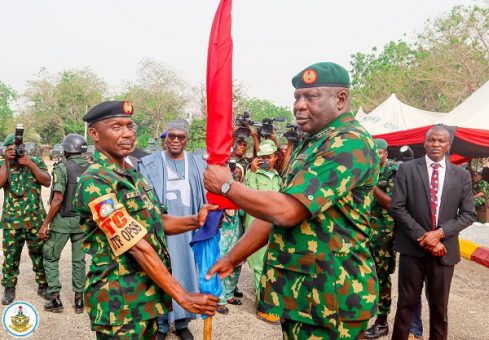
On Thursday, 19 February 2026, at the historic Sobi Barracks in Ilorin, Kwara State did more than launch a security operation. It signalled a recalibration. The formal flag-off of Operation Savannah Shield by Governor AbdulRahman AbdulRazaq alongside the Chief of Defence Staff, General Olufemi Oluyede, the Chief of Army Staff, Lieutenant General Waidi Shaibu, senior Nigerian Army commanders and heads of security agencies represented a strategic adjustment to a changing threat landscape.
Having covered Nigeria’s major military theatres for nearly a decade — from Operation Sharan Daji to Operation Accord and to Operation Sahel Sanity and now Hadarin Daji in the North-West to Operation Delta Safe in the South-South and Operation Safe Haven and Operation Whirl Stroke in the North-Central — I have come to understand that recalibration, not reaction, defines sustainable security. Savannah Shield is best understood within that framework: a preventive correction designed to interrupt an emerging trajectory before it hardens into crisis.
Kwara’s security story over the past two years has been one of gradual but undeniable pressure. Between 2024 and 2025, reported kidnapping incidents in some parts of Kaiama and Baruten Local Government Areas raised alarm within security circles. National crime tracking datasets and internal security briefings presented in Abuja in late 2025 reflected a broader pattern: North-Central Nigeria recorded an increase in abduction cases year-on-year, mirroring spillover effects from the North-West’s entrenched banditry networks.
READ ALSO: NEPZA, Borno Partner To Resuscitate Banki Trade Zone
Kwara was not yet a frontline theatre. But it was no longer peripheral. Geography partly explains the vulnerability. The state shares strategic boundaries with Niger State to the north and Kogi to the east, while expansive savannah woodland and forest belts — particularly near Kainji Lake — provide concealment corridors. In conflict reporting, terrain is destiny. In Zamfara, forests became staging grounds for bandits. In Kaduna, forest belts enabled mobile kidnapping cells. Kwara’s terrain, if left insufficiently policed, risked similar exploitation.
It is important to distinguish threat types accurately. Kwara is not contending with a large-scale ideological insurgency akin to Boko Haram’s campaign in Borno. The dominant security pattern has been criminal banditry — kidnapping for ransom, cattle rustling and sporadic attacks targeting vulnerable communities. Yet the distinction offers little comfort if criminal enclaves begin to entrench themselves. Across Nigeria, the line between economic criminality and violent extremism has proven porous when safe havens emerge.
Operation Savannah Shield therefore represents an anticipatory defence. Its structure reflects lessons from other theatres. Rather than a fragmented deployment, it integrates the Nigerian Army, Nigeria Police Force, Nigeria Security and Civil Defence Corps and intelligence services under coordinated planning. Area domination patrols, forest clearance missions and rapid-response operations are being conducted simultaneously with intelligence gathering and surveillance.
The February 19 launch was not ceremonial theatre. It followed months of consultation between the Kwara State Government and federal authorities. Governor AbdulRahman AbdulRazaq’s engagement with the Presidency and defence leadership secured additional military reinforcement. The visible presence of the Chief of Defence Staff at the launch conveyed federal seriousness — a signal that Kwara’s recalibration had national backing.
From a factual standpoint, the state government has not limited itself to rhetoric. In the 2025 fiscal cycle, budgetary allocations supporting security logistics were increased. Confirmed procurement of patrol vehicles and communication equipment enhanced operational mobility. Community policing initiatives were expanded, and liaison structures strengthened between security agencies and traditional institutions.
Mobility and intelligence are operational currencies. In Kaduna between 2021 and 2023, the integration of aerial surveillance and ground coordination under Operation Thunder Strike reduced high-profile highway kidnappings along key corridors. In Zamfara, initial fragmentation under Operation Hadarin Daji slowed results until unified command structures were enforced. Kwara appears to have internalised those lessons from inception.
Since the launch of Operation Savannah Shield, early field reports suggest measurable improvements in patrol visibility along previously vulnerable routes. Residents in parts of Kwara North have reported increased security presence compared with late 2025. Security officials privately confirm that sustained patrol cycles have disrupted criminal mobility patterns. While comprehensive operational statistics remain confidential for tactical reasons, the qualitative indicators point to stabilisation momentum.
But recalibration demands depth, not just deployment. The sustainability question looms large. Military offensives can suppress activity; lasting stability depends on institutional reinforcement. The Nigeria Police Force in Kwara must build intelligence capacity and data-driven crime mapping systems to assume long-term stabilisation roles once immediate military pressure reduces threat intensity.
In every theatre I have covered, gains proved fragile when civilian policing capacity lagged behind military success.
Judicial coordination is equally critical. Arrested suspects must face timely prosecution. Kaduna’s experience in strengthening prosecution processes between 2022 and 2023 offers a useful blueprint. Deterrence is anchored not merely in arrest numbers but in the certainty of consequence. Kwara’s Ministry of Justice must align operational tempo with judicial throughput.
Security recalibration also intersects with economic policy. Kwara’s northern agricultural belt contributes significantly to food production. When insecurity disrupts planting and harvesting cycles, economic ripple effects follow — affecting markets, employment and food inflation. By stabilising rural communities, Savannah Shield safeguards both livelihoods and macroeconomic resilience.
Inter-state coordination will determine whether recalibration endures. Criminal networks relocate under pressure. I observed this dynamic in the North-West, where offensives in one state displaced bandits into neighbouring territories. Kwara must institutionalise intelligence-sharing protocols with Niger, Kogi, Oyo and Osun to prevent displacement cycles. A shield is only as strong as its perimeter.
Public communication deserves commendation. Transparent advisories and engagement with community leaders have sustained trust. In conflict zones, misinformation amplifies fear and undermines operations. Kwara’s measured communication approach counters panic while reinforcing cooperation.
Of course, realism tempers optimism. Security operations demand sustained funding. Logistics, fuel, maintenance and personnel welfare cannot be episodic. If Savannah Shield is to remain effective beyond its launch phase, fiscal consistency must accompany strategic clarity.
Yet what distinguishes Savannah Shield is not perfection but intent backed by structure. The recalibration is evident in three dimensions: anticipatory deployment before escalation, integrated command rather than siloed action, and alignment between security and development policy.
From a regional lens, the significance is broader. North-Central Nigeria is a strategic hinge between insurgency-prone North-East and bandit-dominated North-West. Preventing entrenchment in relatively stable states like Kwara strengthens national security coherence. Savannah Shield contributes to that containment logic.
After nearly a decade reporting from Nigeria’s security corridors, I have learned that the most meaningful victories are incremental. They manifest in reopened schools, functioning markets and uninterrupted farming seasons. They are measured in the quiet return of routine.
Kwara’s recalibration signals an understanding that waiting invites escalation. Acting early reduces long-term cost — human and economic. The February 19 launch was therefore less about spectacle and more about strategic timing.
Savannah Shield is not a silver bullet. No operation is. But it is a structured assertion that Kwara will not surrender its harmony to creeping insecurity. It is a commitment that governance will adapt to emerging threats rather than deny them.
In a national landscape often fatigued by crisis headlines, Kwara’s approach offers a measured alternative: acknowledge vulnerability, mobilise partnership, invest in logistics, align institutions and communicate transparently.
Security recalibration is not merely about raising a shield. It is about strengthening the arm that holds it and reinforcing the society it protects. If sustained with discipline, institutional learning and inter-state cooperation, Savannah Shield can become more than an operation. It can become a model of preventive governance in North-Central Nigeria and beyond.
Alabidun is a media practitioner and can be reached via alabidungoldenson@gmail.com


