
TMS Empowers 200 in Bayelsa, Engages Residents on Tinubu’s Reforms
 0
 0
TMS Empowers 200 in Bayelsa, Engages Residents on Tinubu’s Reforms
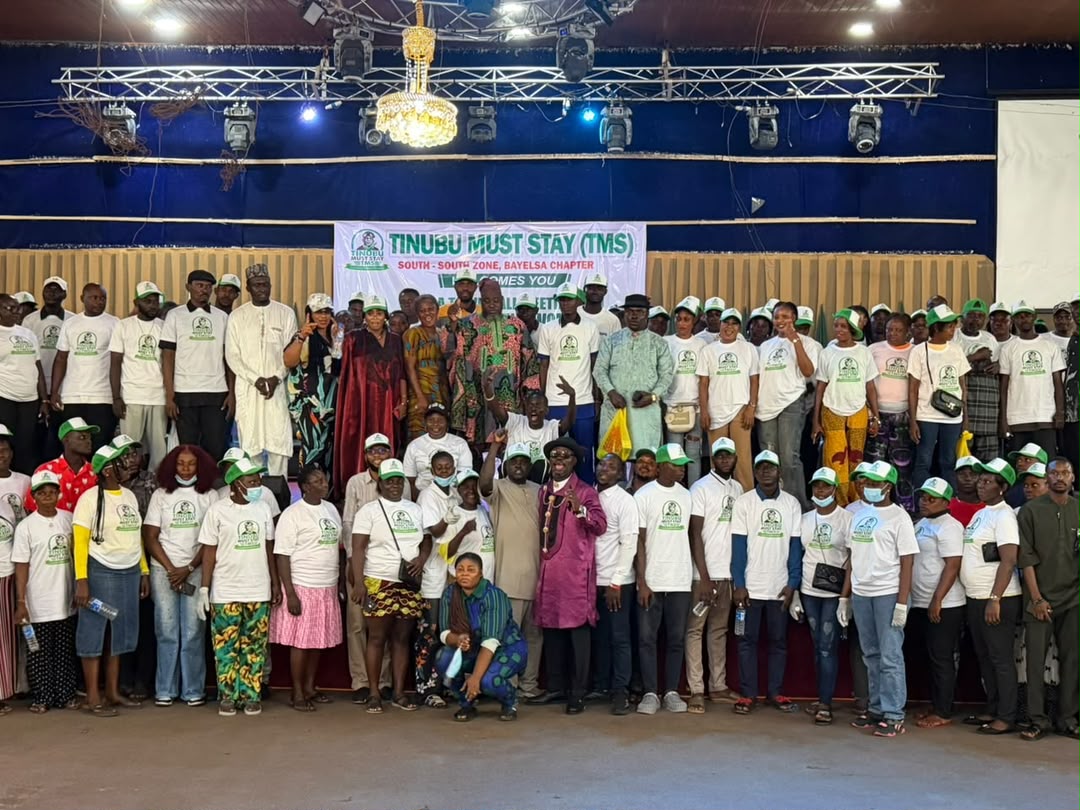
The Tinubu Movement For Sustainable Governance Foundation known as Tinubu Must Stay (TMS) Movement has organised a Town Hall Meeting and Industrial Training Workshop in Bayelsa State, bringing together political stakeholders, community leaders, women and youths to discuss economic reforms, grassroots empowerment and sustainable governance under President Bola Ahmed Tinubu’s administration.
The event, held under the theme, “Empowering Nigerians for the Better,” featured a keynote address on the economic reforms of the Tinubu administration, interactive discussions and practical skills acquisition training, with over 200 participants trained in soap making.
In his welcome address, the South-South Zonal Coordinator of TMS, Comrade Ogio Bright Clement, described the gathering as an opportunity to promote economic empowerment, strengthen grassroots participation and consolidate support for the Renewed Hope Agenda.
READ ALSO: Tinubu’s entry into Ka’abah, mark of respect for Nigeria – TDF
He said empowerment should go beyond political slogans to include equipping young people with practical skills, supporting women to become economically independent and providing communities with opportunities to improve their livelihoods.
According to him, the Tinubu administration has demonstrated commitment to the development of the South-South region through infrastructure projects and empowerment initiatives.
Clement urged youths and women to take advantage of the industrial training programme, describing skills acquisition as an important pathway to economic independence.
He also called on TMS coordinators across Bayelsa, Rivers, Delta, Edo, Akwa Ibom and Cross River states to intensify grassroots mobilisation and promote unity within the movement.
In his goodwill message, the National Coordinator and Chairman of the TMS Board of Trustees, Mallam Kashifu Inuwa Abdullahi, who was represented by the Director of Mobilisation and Data Management, Engr. Ibrahim Said Uba, commended the Bayelsa State chapter for organising the programme.
He said the initiative reflected the movement’s commitment to human capital development, youth empowerment, civic participation and sustainable governance.
Uba highlighted several federal infrastructure interventions in Bayelsa, including the Ogbia-Nembe Road and Bridges, the Oruma Rigid Pavement Road, the ongoing Nembe-Brass Road project and rehabilitation works along sections of the East-West Road.
He also mentioned road projects linking Otuasega, Obedum and Emelego, Ologi, Sangatama and Akipelei communities, noting that such investments were important for improving connectivity, stimulating local commerce and expanding economic opportunities.
While acknowledging that some of the projects predated the current administration, he said their continuation, advancement and commissioning demonstrated the importance of sustained government commitment to infrastructure development.
The TMS national leadership representative further emphasised that investment in human capital was as important as physical infrastructure, urging participants to embrace vocational training, entrepreneurship, innovation and productive ventures.
He stressed that the movement’s responsibility extended beyond political mobilisation to include constructive engagement, accountability and initiatives capable of improving the living conditions of ordinary Nigerians.
At the interactive session, participants raised concerns about access to federal government empowerment programmes, particularly for vulnerable groups and people living in rural communities.
One of the participants, Victoria Okoto, a leader of persons with disabilities in Southern Ijaw, asked how people living with disabilities could benefit from the Tinubu administration’s training and empowerment initiatives, including the Three Million Technical Talent (3MTT) programme, Presidential Conditional Grant Scheme (PCGS) and CREDICORP.
Similarly, Ebikebina Comfort Philip, a former councillor in Southern Ijaw, expressed concern about how the benefits of government programmes could effectively reach people at the grassroots, particularly residents of remote communities.
Responding to the concerns, Uba assured participants that the administration was pursuing strategies to expand access to empowerment opportunities and improve the welfare of Nigerians.
He emphasised the importance of ensuring that government interventions reached communities and vulnerable groups, while encouraging participants to remain engaged with relevant institutions to access available opportunities.
Earlier in his keynote address, Dr Anthony Chukwuebuka Okoye of the Department of Political Science, Federal University Otuoke, Bayelsa State, examined the economic reforms of the Tinubu administration under the topic, “Economic Reforms: The Pain, the Gains and the Future of President Bola Ahmed Tinubu’s Administration.”
Okoye traced the economic challenges confronting Nigeria when Tinubu assumed office in May 2023, including the petrol subsidy burden, mounting debt-servicing obligations, foreign exchange market distortions and fiscal difficulties facing state governments.
He identified petrol subsidy removal, foreign exchange market reforms and comprehensive tax restructuring as three major policy decisions introduced by the administration to address structural weaknesses in the economy.
According to him, although the reforms have imposed significant hardship on Nigerians through increased transportation costs, inflationary pressures and reduced purchasing power, they were intended to establish a more sustainable economic foundation.
The political scientist also highlighted improvements in some macroeconomic and fiscal indicators, including GDP growth, foreign reserves, tax revenue and Federation Account Allocation Committee (FAAC) disbursements.
However, he cautioned that improvements in economic statistics must translate into tangible benefits for ordinary Nigerians.
He noted that increased foreign reserves and government revenue would have limited significance to citizens if they did not result in affordable food, better employment opportunities, improved purchasing power and access to essential services.
Okoye identified security, reliable electricity, infrastructure development and accountability as critical factors that would determine the success of the reforms.
He further observed that Nigeria’s ambition of becoming a $1 trillion economy by 2030 would depend on sustained policy implementation, increased investment, industrial development and improved productivity.
The keynote speaker concluded that the ultimate measure of the reforms should be their impact on the living conditions of Nigerians, stressing that economic adjustments must produce inclusive prosperity.
A major highlight of the event was the practical industrial training, during which more than 200 participants received training in soap making, alongside support and mentorship designed to encourage them to turn the acquired skills into income-generating ventures.
Participants expressed appreciation to President Tinubu for his economic reform initiatives and commitment to improving the country, while acknowledging the need for government programmes to deliver more visible benefits at the grassroots.
The event ended with renewed calls for unity, skills acquisition, entrepreneurship and stronger collaboration between government, communities and civil society organisations to advance development in Bayelsa State and the South-South region.


