COLUMN: Tinubu, EFCC and the Danger of Political Interference
 0
0
 0
0
COLUMN: Tinubu, EFCC and the Danger of Political Interference
By Alabidun Shuaib AbdulRahman
There are moments when the intention behind an official decision may be defensible, yet the decision itself opens a door that ought to concern every citizen. President Bola Ahmed Tinubu’s intervention in the Economic and Financial Crimes Commission’s freezing of an Osun State Government account is one of those moments.
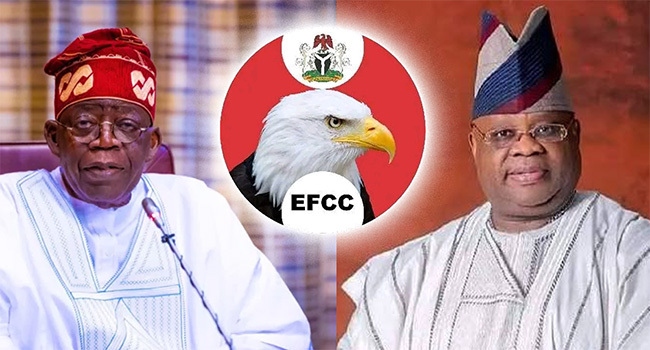
On August 6, 2026, with the Osun governorship election only nine days away, Tinubu directed the EFCC to return to court, vacate the order freezing an account belonging to the Osun State Government and discontinue the action it had instituted. The President said he was “deeply embarrassed” not by the EFCC’s exercise of its mandate, which he acknowledged was backed by a court order, but by its timing.
His explanation was understandable. Tinubu said actions taken by federal institutions were ordinarily attributed to him as President, whether or not he had prior knowledge of them. Since the election was approaching, he argued, nothing should be done that could create the impression that the EFCC or another Federal Government agency was being used to influence the election.
READ ALSO: IYD: ACOE Tasks Nigerian Youths to Shun Violence, Embrace Civic Participation
The argument is “morally” correct. But it also creates a difficult constitutional and institutional question: where does legitimate presidential concern about an election end and operational interference in an anti-corruption agency begin?
The EFCC did not arbitrarily descend on Osun. The commission said it had observed “huge transfers of funds into different corporate entities” from the state account and had acted to halt what it considered suspicious movement of public money. It argued that the approaching election could not become an excuse for an anti-corruption agency to ignore suspected movement of public funds.
Governor Ademola Adeleke, however, said the account was used for workers’ salaries and had been placed on a “Post No Debit” status. He demanded an explanation from EFCC Chairman Ola Olukoyede and described the action as another assault on Osun’s democracy.
The political atmosphere surrounding the matter had also been poisoned long before the account was frozen. In June, the Diaspora Committee of the All Progressives Congress Governorship Campaign Council in Osun asked the EFCC to freeze accounts allegedly connected with a reported N13.7bn annual ghost-workers payroll scandal. The committee claimed the money could be diverted to finance vote-buying ahead of the August 15 election. That background makes the EFCC’s action politically sensitive. But sensitivity is precisely why institutional independence matters.
The EFCC is a creation of statute. Under the EFCC (Establishment) Act, its chairman and members are appointed by the President, subject to Senate confirmation, while the law also provides for the chairman’s tenure and removal. The Presidency therefore has substantial influence over the commission’s leadership. That, however, does not make the President the operational head of every EFCC investigation.
There is an important distinction between constitutional authority over an institution and operational control of its investigations. A President may appoint the EFCC chairman, exercise statutory powers concerning the office, formulate broad government policy and demand accountability from federal agencies. But an anti-corruption agency must retain sufficient operational independence to determine whom to investigate, what evidence to pursue and what enforcement action to take.
Curiously, Tinubu himself made this case in the same statement. He said that since assuming office in May 2023, he had consistently maintained that anti-corruption and law-enforcement agencies should perform their statutory responsibilities independently and professionally, “without fear or favour, or political interference.” He added that he had deliberately refrained from directing or interfering in EFCC operations. That is why the Osun intervention becomes more concerning.
If a President can intervene in an operational decision because its timing might create an appearance of political interference, then the President has necessarily exercised influence over an operational decision. That does not automatically make the intervention unlawful. But it creates a precedent that future administrations may exploit.
Tinubu may genuinely believe the EFCC action could have been interpreted as an attempt to influence the Osun election. Another President could make the same argument about an investigation involving a governor, a minister, a major campaign financier or a politically influential contractor. If the principle becomes that the Presidency can intervene whenever enforcement action creates political controversy, the exception could eventually swallow the rule.
Nigeria’s history with the EFCC offers enough warnings. The commission was established in 2002 and began operations under President Olusegun Obasanjo, with Nuhu Ribadu becoming its pioneer chairman in 2003. Ribadu’s aggressive pursuit of governors, ministers, bankers and other powerful Nigerians gave the EFCC international prominence. But his controversial removal in 2007 also generated questions about the vulnerability of the commission to presidential and political interests.
Farida Waziri’s tenure produced another controversy. Appointed by President Umaru Musa Yar’Adua in 2008, she was removed by President Goodluck Jonathan on November 23, 2011. Years later, Waziri alleged that Jonathan’s administration had interfered with investigations and that her refusal to back down from a probe contributed to her removal. Though Jonathan rejected the allegation and challenged her to identify whom he had allegedly ordered her not to investigate.
The significance of those disputes is not simply who was right. It is that Nigerians repeatedly witnessed a situation in which the political leadership had enormous influence over the institution expected to investigate politically powerful people.
The Muhammadu Buhari administration provided another example. Buhari appointed Ibrahim Magu as acting EFCC chairman in 2015, despite the controversy that followed the Senate’s rejection of his nomination for substantive confirmation. On July 10, 2020, Buhari approved Magu’s suspension to allow a presidential panel to investigate allegations against him.
Again, the larger issue was institutional. The leadership of the EFCC remained heavily dependent on the Presidency, even though the commission’s work could directly affect members and allies of the governing political establishment. That is the weakness Nigeria has failed to resolve.
The President appoints the EFCC chairman. The commission investigates people who may have enormous political connections. The chairman therefore operates within an institutional structure in which the most powerful political office in the country has significant influence over the leadership of the agency.
This is why the Osun matter cannot be reduced to whether Tinubu had the right to be concerned about the election. Of course, he did. Elections must be protected from intimidation, manipulation and the misuse of state institutions. The harder question is whether that legitimate concern should be exercised through a presidential direction concerning a live EFCC enforcement matter.
There is also an important constitutional distinction regarding Adeleke. Section 308 of the 1999 Constitution grants a sitting governor immunity from civil or criminal proceedings in specified circumstances. But immunity is not exoneration. It does not mean a governor cannot be investigated, that evidence cannot be gathered or that public funds associated with a state government are beyond investigation.
If the EFCC had credible evidence of suspicious transfers, Adeleke’s candidacy should not automatically extinguish the commission’s investigative responsibility. Conversely, the approaching election should not give the EFCC licence to turn an investigation into a political weapon. The law must be stronger than both impulses.
That is why the better solution should have been procedural rather than presidential. If the EFCC had obtained a freezing order from a court and concerns subsequently arose about its timing or effect on essential state services, those concerns could have been presented before the court. If salaries needed to be paid, the government could have sought appropriate judicial relief.
Adeleke, too, must allow due process to take its course. If the EFCC acted unlawfully, the courts provide the remedy. If the allegations are false, evidence and due process should establish that fact.
For Olukoyede, the lesson is equally clear. The EFCC’s greatest asset is not proximity to the President but distance from political instruction. The commission must be prepared to investigate opposition politicians and members of the ruling party, governors and former governors, ministers and political financiers according to the same evidentiary standard.
Tinubu’s intervention, even if motivated by a legitimate desire to protect the integrity of the Osun election, should concern Nigerians. Institutions survive governments. Presidents come and go. Political parties win and lose elections.
If Tinubu truly wants Nigerians to believe that the EFCC is independent, the next step is obvious. He should help build an institutional framework in which no future President will need to intervene to prove that the EFCC is not being used politically. That is the real test of leadership. And that is the difference between fighting corruption under a President and building a country where the fight against corruption does not depend on the President.
Alabidun is a media practitioner and can be reached via alabidungoldenson@gmail.com